
Cherry Audio Harmonia Sound Design: Modulating Spectra with LFOs
How can you use Harmonia's Initial Level, Center and Width controls with LFO modulation to create evolving spectral movement and changing timbres?
From a static spectrum to a changing sound
One of the most interesting aspects of Cherry Audio's Harmonia is not simply that we can combine eight frequency layers. It is that we can change the balance between those layers over time.
If we want a sound whose spectral balance remains static, the broad orange bars in Harmonia's oscillator section provide the essential controls. They set the amplitude of the individual layers. With a suitable source sound and tuning, we can establish a stable spectrum and then shape the result using the rest of the synthesizer.
But static spectra are only the beginning. Harmonia also offers a set of controls that allow the actual levels of the frequency layers to move in a coordinated way.
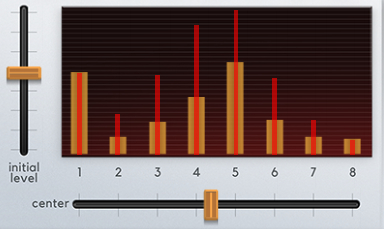
The key is to understand the relationship between Initial Level, Center and Width.
Orange bars and red bars: two kinds of level
The broad orange bars show the amplitude settings for the individual frequency layers. These provide the basic balance between the layers.
The smaller red bars indicate the resulting levels when Harmonia's Initial Level, Center and Width controls are taken into account.
When Initial Level is set to zero, the red bars correspond to the levels established by the orange bars. As Initial Level increases, the red bars can rise above those original settings, increasing the effective level of selected layers.
Which layers are affected depends on two additional controls:
- Center determines the central position of the group of layers receiving the level increase.
- Width determines how broadly that influence extends across the layers around the center.
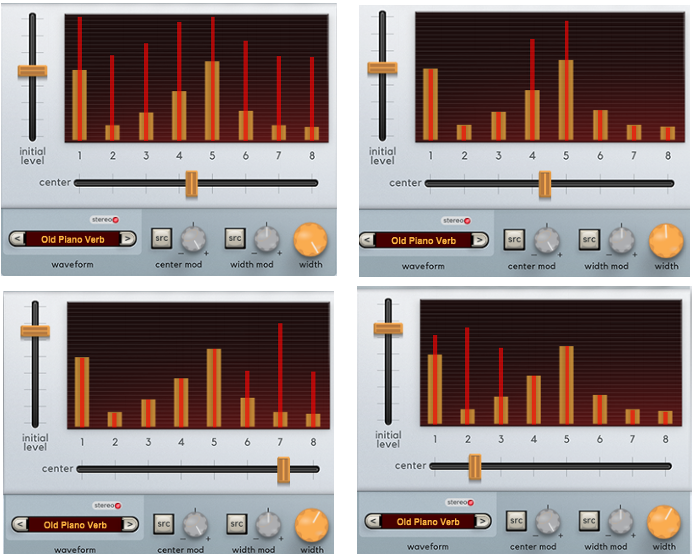
Together, these controls provide a way to emphasize different parts of the oscillator's layered structure.
The important point is that Center and Width do not have to remain fixed. When we modulate them, the distribution of amplitude across the eight layers changes over time. The result is a moving spectral balance rather than a static collection of frequencies.
Why the controls make more sense in motion
Looking at a collection of red bars in a still image may not immediately reveal the musical potential of these controls. A static configuration can look arbitrary: why emphasize this group of layers rather than another?
The answer becomes much clearer when the controls are moving.
Imagine that Center slowly travels from one end of the eight-layer structure to the other. As the emphasized region moves, different layers become more prominent. If the layers contain different samples, or if they are tuned to different frequencies, the sound changes in both timbre and spectral balance.
Now imagine modulating Width as well. A narrow setting can concentrate the emphasis around a smaller group of layers, while a broader setting can distribute it across more of the structure.
The interaction between Center and Width creates a moving pattern of emphasis. Depending on the source material and tuning, this may sound like a shifting resonance, a changing orchestral colour, an evolving drone or a complex animated pad.
This is especially useful for ambient music and generative sound design, where a sound can remain recognizable while continuously changing its internal character.
A practical experiment with two LFOs
Here is a simple example from my own Harmonia experiments.
In the linked video, the Center position of the dynamic layer levels is modulated by LFO 1 at a rate of 0.40 Hz. The Width parameter is modulated by LFO 2 at a much slower rate of 0.08 Hz.
The two rates serve different purposes. LFO 1 moves the emphasized region relatively quickly, while LFO 2 slowly changes how many neighbouring layers are included in that region.
Watch the Harmonia spectral-modulation example
The rates are starting points rather than universal settings. The best values depend on the material, the tuning, the musical duration and how quickly you want the timbre to evolve.
Building the patch step by step
Try the following approach:
- Choose a source sound. Begin with a sustained sample, such as a drone, vocal or orchestral sound. You can also start with a basic waveform if you want a simpler spectrum.
- Set the frequency relationships. Choose harmonic ratios for a more overtone-oriented structure, or semitone offsets for a more chordal or clustered sound.
- Balance the orange bars. Establish a useful starting balance between the eight layers. There is no need to make every layer equally loud.
- Raise Initial Level. Increase it enough to make the red bars' dynamic behaviour clearly audible.
- Adjust Center and Width. Find a configuration in which movement across the layers produces a noticeable but musically useful change.
- Assign a slow LFO to Center. Start with a moderate rate, then slow it down until the movement feels appropriate for the sound.
- Assign another LFO to Width. Begin with a slower rate than the Center modulation. Listen to how the size of the emphasized region changes.
- Adjust the depth and rates. If the sound changes too dramatically, reduce the modulation amount. If the motion is barely perceptible, increase the depth or choose a source with more contrasting layers.
The aim is not necessarily to make the sound more dramatic. Often the most interesting result is a subtle change that becomes apparent only when you listen over a longer period.
Using Harmonia's modulation sources
Harmonia offers a useful range of modulation sources for this kind of work:
- Four LFOs
- Two envelope generators
- The two oscillators themselves
- Mod Wheel
- Pitchbend
- Keyboard CV
- Velocity
- Channel pressure
- Polyphonic aftertouch
- White noise
- Pink noise
- Mono random DC
- Polyphonic random DC
- A +10 V DC source
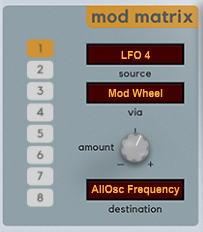
The available sources make it possible to approach spectral movement in several ways.
Periodic movement
An LFO provides predictable, repeating motion. Two LFOs operating at different rates can create patterns that continually change in relation to each other. This is useful for sustained textures, drones and slowly evolving pads.
Performance-controlled movement
Mod Wheel, velocity, channel pressure and polyphonic aftertouch can bring spectral movement under the player's control. For example, a performance gesture can gradually shift the Center position or broaden the Width setting.
The precise result depends on the modulation assignment and its depth. The important idea is to make expressive performance alter the sound's internal structure, not just its overall volume.
Random and noise-based movement
Noise and random DC sources offer less predictable alternatives to periodic LFOs. Depending on how a source behaves and how it is routed, it can introduce irregular variation rather than a clearly repeating cycle.
This can be useful when a perfectly periodic modulation sounds too mechanical. Use modest amounts at first: random changes can easily turn subtle movement into unstable or distracting fluctuations.
Extending the idea beyond Center and Width
Harmonia's modulation system is not restricted to the controls that determine the moving level distribution. Its modulation sources can also be assigned to many other targets, including:
- Oscillator glide and frequency
- Oscillator Initial Level and Width
- Individual oscillator-layer parameters
- LFO rates and bias
- Mixer level and panorama
- Filter cutoff, resonance, envelope amount and tracking
- The stages of both envelope generators
- Distortion controls
- Modulation-effects controls
- Echo controls
- Reverb controls
This means that spectral movement can become one part of a much larger evolving system. For example, Center could move slowly while the filter cutoff follows a separate LFO, and the reverb mix could rise and fall over an even longer period.
The key is to avoid modulating everything merely because the option exists. Assign each movement a purpose, and listen to the combined result over a full phrase or longer passage.
A sound-design principle worth keeping
A sound does not have to change pitch to feel alive. It can remain on a single note while its internal frequency balance shifts, its spatial position changes and its effects evolve.
Harmonia's Center and Width controls make this principle unusually accessible. Rather than adding complexity through more notes, we can create movement inside the sound itself.
For ambient, drone-based and generative music, this can be a valuable compositional technique: keep the musical surface simple while allowing the timbre to develop over time.