
Major and Minor Chords Explained: Build Triads on Your Synthesizer
How do you build major and minor chords from three notes, and what is the difference between them?
Major and Minor Chords Explained: Building Three-Note Triads
Chords are one of the most useful tools for turning individual notes into harmony. They can give a melody a sense of stability, tension, brightness, darkness, or movement. You don't need to learn hundreds of chords to start experimenting: a good place to begin is with two basic types, major and minor triads.
A triad is a chord built from three different notes. Those notes can be played together, and one or more of them can also be doubled in another octave. This is common in keyboard playing and orchestration.
Building a major chord
One of the best-known chords is C major, usually written as C major or Cmaj. Its notes are:
C – E – G
You can build this chord by taking the first, third, and fifth notes of the C major scale:
- First note: C
- Third note: E
- Fifth note: G
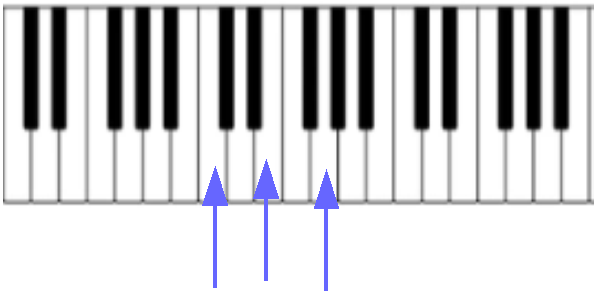
You can also understand the chord through the distances between its notes. From C to E is four semitones; from E to G is three semitones.
In other words, a major triad has this interval pattern:
Root → four semitones → three semitones
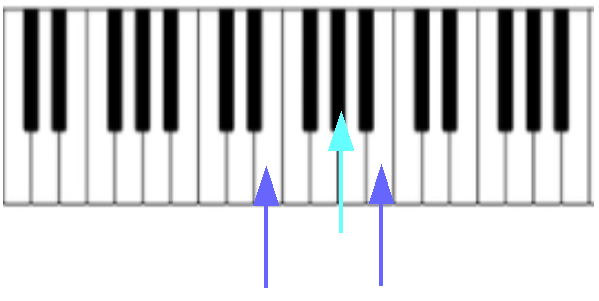
For example, an E major chord contains:
E – G♯ – B
The interval from E to G♯ is four semitones, and the interval from G♯ to B is three semitones. This is the same pattern as C major, transposed to a different starting note.
Building a minor chord
A minor triad uses the opposite arrangement of these two intervals:
Root → three semitones → four semitones
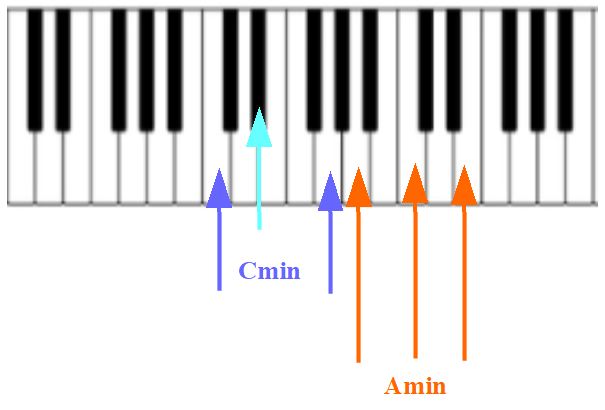
For example, C minor contains:
C – E♭ – G
The distance from C to E♭ is three semitones, and the distance from E♭ to G is four semitones.
A minor triad can also be built on A:
A – C – E
From A to C is three semitones, and from C to E is four semitones.
Major versus minor
The difference between these two chord types comes down to one note in the basic examples:
- C major: C – E – G
- C minor: C – E♭ – G
The fifth, G, stays the same. The third changes from E to E♭, changing the chord from major to minor.
Major chords are often described as bright or stable, while minor chords are often described as darker or more melancholic. These are useful first impressions, not fixed emotional rules. The surrounding harmony, rhythm, register, timbre, and musical context all affect how a chord is perceived.
Try it with a synthesizer
If you have a keyboard or a synthesizer that can play several notes at once, try the following:
- Play C–E–G together.
- Lower E by one semitone to E♭.
- Listen to how the character of the chord changes.
- Repeat the experiment with other root notes.
If you use a modular synthesizer, you can also send three separate pitch-control voltages to three oscillators and mix their outputs. Try changing only the pitch of the middle note while keeping the root and fifth in place.
You can also use a quantizer or a chord-generation module to produce the notes, then experiment with different oscillator waveforms, octave ranges, filters, and envelopes. The chord supplies the pitches; the sound design determines much of their timbral character.
Where to go next
Once you can build major and minor triads, the next step is to learn how to rearrange their notes. The same three notes can produce different voicings depending on which note sits at the bottom. These arrangements are called chord inversions.
You can then combine chords into progressions, using them as the harmonic foundation for melodies, bass lines, and evolving electronic textures.