Using Pitch Dependency in Generative Music
How Can Pitch Control Other Musical Parameters in Generative Music?
Using Pitch Dependency in Generative Music
Most modular patches treat pitch as an isolated parameter. A note is generated, and other aspects of the sound behave independently. Generative composition offers another possibility: making other parameters depend directly on pitch.
What Is Pitch Dependency?
Pitch dependency means that the pitch of a note influences other characteristics of the sound.
Examples include:
Higher notes becoming shorter.
Lower notes becoming longer.
Bright sounds appearing at high pitches.
Increased reverb at certain pitch ranges.
- Different modulation depths depending on note height.
Instead of several independent processes, the patch creates relationships between musical dimensions.
Why It Works
Listeners often perceive relationships more strongly than individual events.
A melody whose note lengths change according to pitch feels more coherent than a melody and note lengths generated independently.
The same is true for effects processing.
When pitch and reverb evolve together, the result feels intentional rather than accidental.
Example Strategy
A simple approach is:
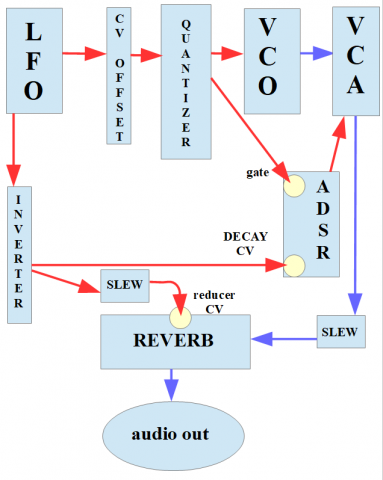
Route pitch CV to the oscillator.
Split the same pitch CV.
Use one copy to control note length.
- Use another copy to control reverb amount.
In this setup:
Higher notes become shorter but more spacious.
- Lower notes become longer and drier.
The resulting interaction creates a recognizable musical identity.
Compositional Benefits
Pitch dependency can:
Create coherence.
Increase recognizability.
Generate natural variation.
- Reduce the feeling of unrelated randomness.
Conclusion
Pitch dependency transforms pitch from an isolated musical parameter into a controlling force that shapes the behaviour of the entire patch.
Just click here to get more details about this topic, including graphs, presets, patches and videos.