
ARP 2600 Prancing Raindrops: Ring Modulation and Sample & Hold
How does the ARP 2600's Prancing Raindrops patch combine ring modulation, Sample & Hold, oscillator cross-modulation and internally triggered envelopes to generate a continuously changing sequence without playing the keyboard?
A patch that plays itself
The ARP 2600 Patch Book contains a patch called “Prancing Raindrops,” number 76. It is an excellent example of how a seemingly complicated patch can generate musical activity without requiring us to play notes on a keyboard.
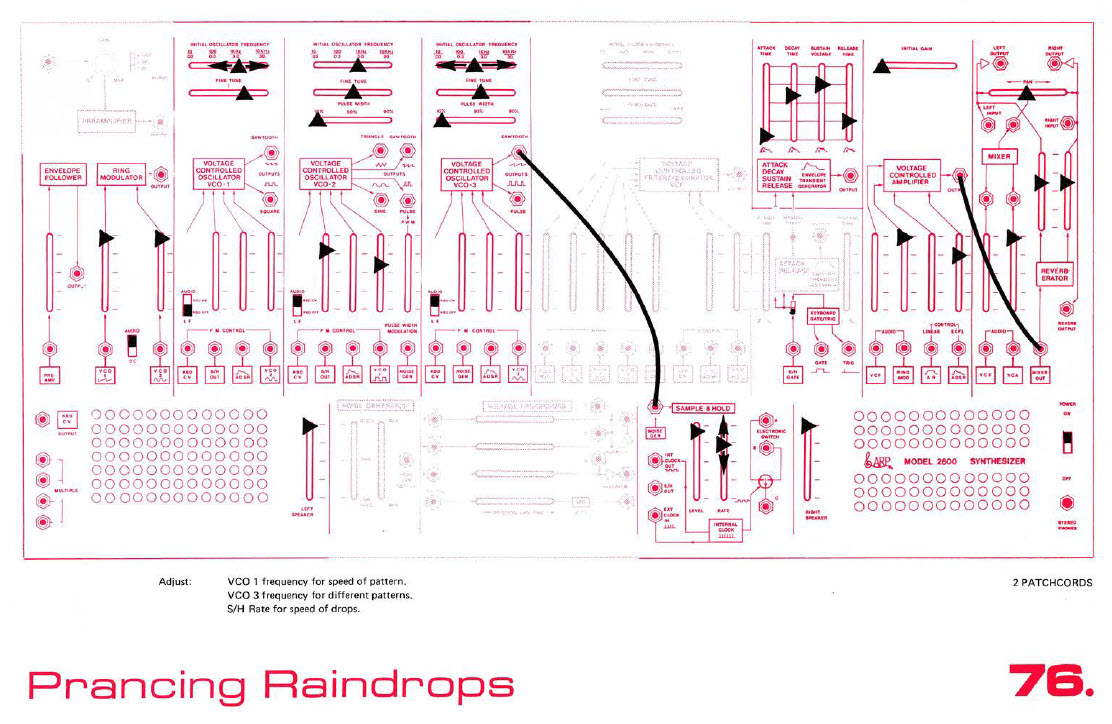
The patch combines two particularly interesting functions: a ring modulator and a Sample & Hold unit. It also uses the oscillators in ways that are not immediately obvious from the patch diagram.
At first glance, several things seem puzzling. Why is one oscillator being modulated even though its audio mixer slider is down? How can the ADSR envelope affect the sound if no keyboard gate is being played? And why does a square wave modulate an oscillator's pitch without producing the harsh, abrupt sound we might expect?
To understand the patch, we first need to examine the two key modules.
What does a ring modulator do?
A ring modulator combines two input signals by multiplying them. When its inputs are sine waves with frequencies (f_1) and (f_2), the output contains components at the sum and difference frequencies:
partial 1 = f_1 + f_2 and partial 2 = f_1 - f_2
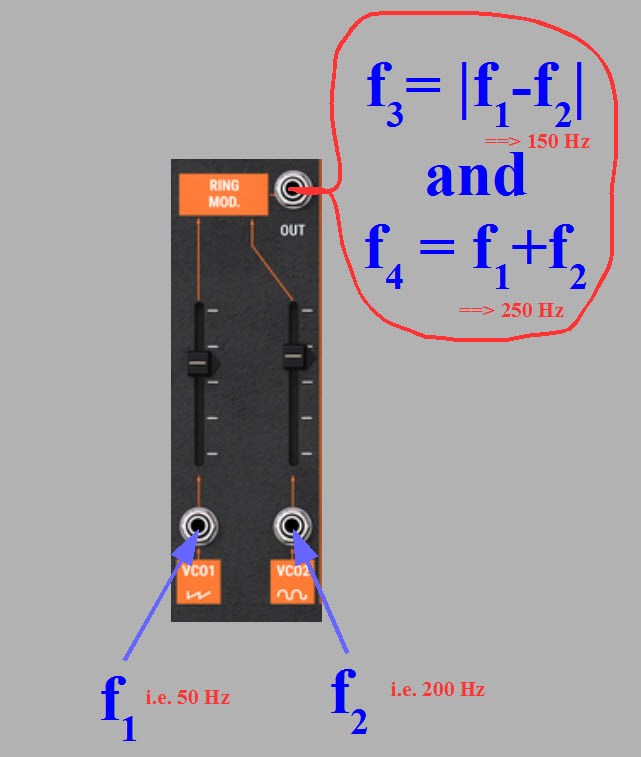
In the ideal case, the two original sine-wave frequencies are not themselves present in the output. Instead, the ring modulator creates new frequency components related to the two inputs.
This is different from simply mixing two oscillators together. A conventional mixer adds the signals, leaving their original frequency components in the result. Ring modulation creates new spectral components through the interaction between its inputs.
When the input signals contain complex waveforms rather than pure sine waves, the situation becomes richer. Each waveform contains multiple frequency components, and their interactions can produce many sum and difference components.
That is why ring modulation can create metallic, bell-like, clangorous or otherwise inharmonic sounds.
Exploring the ARP 2600 ring modulator
The ARP 2600's ring modulator uses the sawtooth wave from Oscillator 1 and the sine wave from Oscillator 2 as its default inputs.
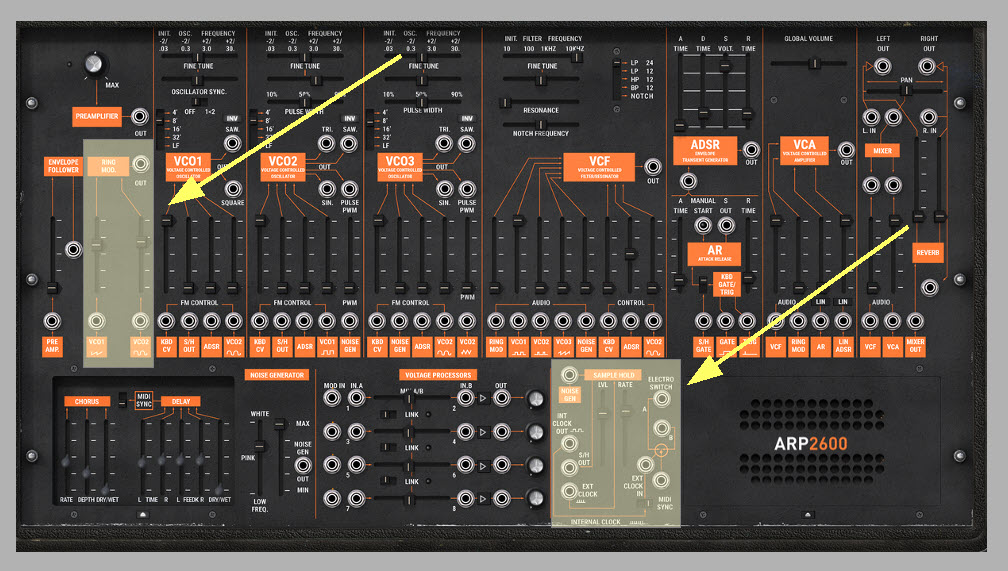
For a clearer demonstration, we can patch the sine wave from Oscillator 3 into the ring modulator's left input. We now have two sine-wave inputs whose interaction is relatively easy to understand.
Bring the ring-modulator output into the filter mixer so that we can hear it. Then bring the original oscillator signals into the mix as well, using their corresponding mixer controls.
This allows us to compare three things:
- The first sine wave by itself.
- The second sine wave by itself.
- The new components created by ring modulation.
Listening to the original signals alongside the ring-modulator output makes the distinction between ordinary mixing and ring modulation much easier to hear.
Which input is the modulated signal?
For this patch, the relationship between the two ring-modulator inputs matters.
If we turn down input 2, the right-hand input, the output follows the signal at input 1. Input 1 is therefore the signal being modulated, while input 2 acts as the modulating signal.
If we turn down input 1, there is no signal for the modulator to act on, and the ring-modulator output becomes silent.
This distinction becomes important later in the Prancing Raindrops patch. Oscillator 1 supplies the signal we hear after ring modulation, while Oscillator 2 supplies the other input that determines how that signal is transformed.
With complex waveforms, ring modulation affects the spectral components of the input signals, creating a much more complicated result than the simple sum-and-difference example with two sine waves.
What does Sample & Hold do?
The second key module is Sample & Hold, often abbreviated to S&H.
Unlike a ring modulator, Sample & Hold is a control-voltage processor. It takes a voltage from an input source, samples that voltage at a particular moment and holds the sampled value at its output until the next sample is taken.
The result is a stepped control signal.
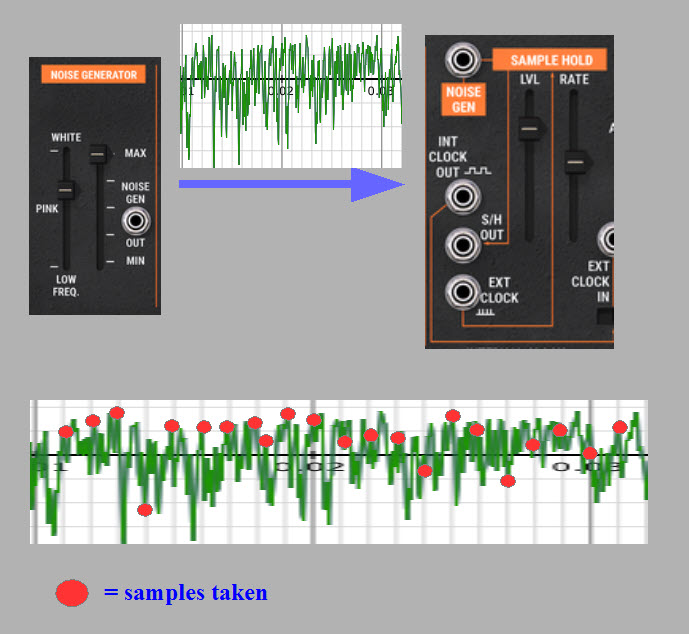
The Rate control determines how frequently the unit takes new samples. The Level control, in the context of this patch, determines the range of the resulting pitch changes.
By default, the ARP 2600's Sample & Hold takes its input from the noise generator. Noise changes rapidly and unpredictably, so sampling it at regular intervals produces a sequence of changing voltage values.
If this voltage is used to control an oscillator's pitch, we hear a sequence of changing pitches.
The result may sound random, but the behaviour has a clear structure: the Sample & Hold determines when a new voltage is captured, and that voltage remains fixed until the next sample.
Sample & Hold does not have to produce random sequences
Noise is only one possible input source.
If we feed a sawtooth waveform into Sample & Hold instead, the unit samples the changing voltage of that waveform. The resulting sequence can be more regular or repeatable than one derived from noise.
The sequence depends on the relationship between the input waveform and the sampling rate. If we change the oscillator frequency while leaving the Sample & Hold rate unchanged, the sampled voltage values can change because the unit encounters different points in the waveform's cycle.
This will become important in Prancing Raindrops, where Oscillator 3 provides the Sample & Hold input.
Understanding the Prancing Raindrops signal path
The patch becomes much easier to understand when we separate its audio path from its control-voltage paths.
The audio path is:
Oscillator 1 → Ring Modulator → VCA → output
Oscillator 2 supplies the other ring-modulator input. Its role is not to provide a separate, direct audio signal at the output. Instead, its changing frequency influences the ring-modulator result.
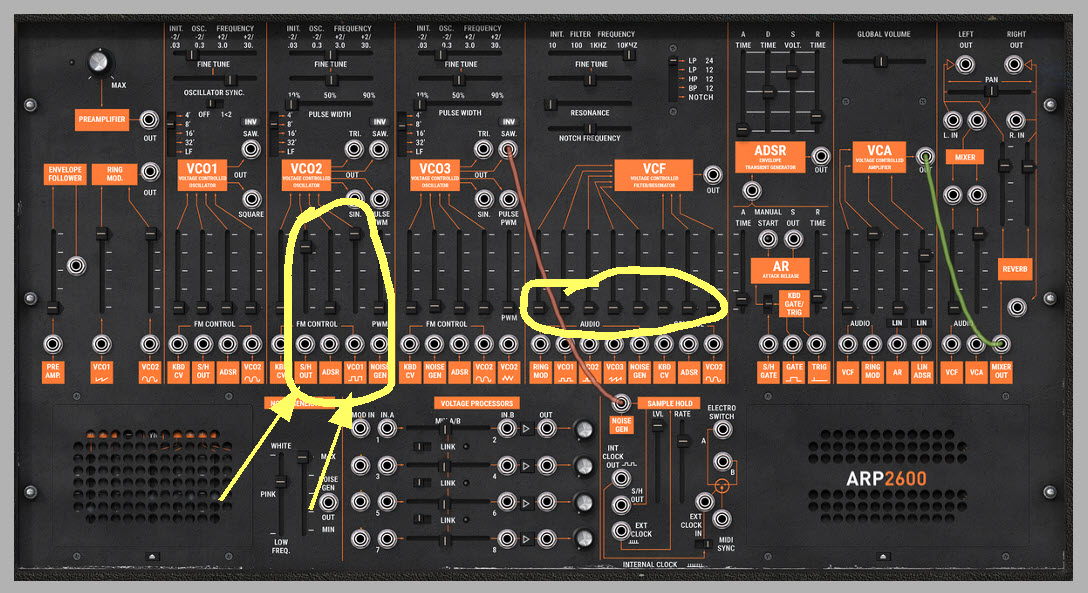
Meanwhile, the Sample & Hold unit controls Oscillator 2's pitch. Oscillator 1 also contributes to the modulation of Oscillator 2, and Oscillator 3 provides the waveform sampled by the Sample & Hold unit.
This is why an oscillator can have its audio mixer slider turned down and still be essential to the sound. Its control signal may be changing the behaviour of another oscillator that does reach the output.
In a modular or semi-modular synthesizer, a module's importance is not determined solely by whether its direct audio output is audible.
The first puzzle: why modulate an oscillator that we cannot hear directly?
In the patch, Oscillator 2 is modulated by the Sample & Hold unit and by Oscillator 1. Yet the audio mixer sliders for these oscillators are not necessarily raised.
Why would we modulate a sound source whose direct audio output is not being mixed into the audible signal?
Because Oscillator 2 is not being used primarily as an audible sound source. Its changing frequency acts as an input to the ring modulator.
The actual audio chain runs from Oscillator 1 into the ring modulator, then into the VCA and out of the synthesizer. Oscillator 2 determines how the ring modulator transforms Oscillator 1's signal.
As the pitch of Oscillator 2 changes, the sum-and-difference relationships at the ring-modulator output change as well. The audible pattern can therefore evolve even though Oscillator 2 itself is not being mixed directly into the output.
This is a useful patching principle: a module can be essential to the audible result without its own output being heard directly.
The second puzzle: how does the envelope run without a keyboard?
The patch also uses the AR envelope generator to control the ADSR envelope. But the sound continues without us pressing keys on the keyboard.
The explanation is the Sample & Hold trigger arrangement.
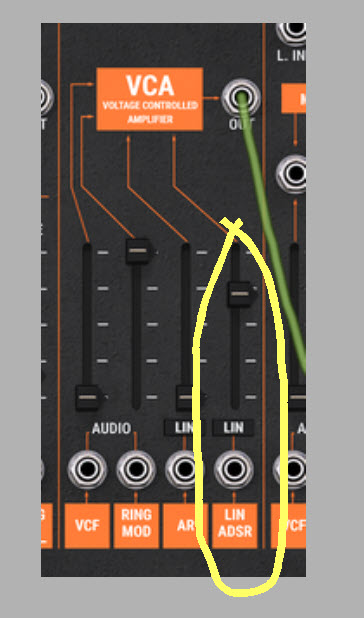
The AR envelope's trigger switch is set to Trigger rather than Keyboard Gate, and its trigger input is supplied by the Sample & Hold unit's internal trigger signal. The AR envelope is therefore triggered according to the Sample & Hold rate rather than by keyboard activity.
The AR envelope then triggers the ADSR envelope, allowing the sound to be shaped repeatedly without requiring a new keypress.
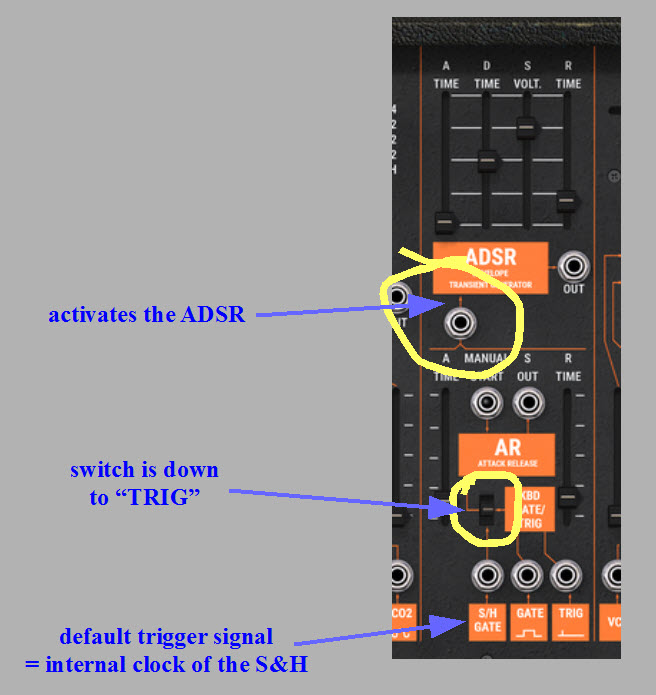
This is the mechanism that helps make the patch self-running. Once the system is set up, its internal timing and modulation relationships keep the sequence moving.
It is important to distinguish this from an ordinary keyboard-controlled envelope. In a conventional patch, pressing a key supplies a gate or trigger that starts the envelope. Here, the Sample & Hold's timing mechanism provides the recurring trigger source.
The third puzzle: why does square-wave pitch modulation not sound harsh?
Oscillator 1's square wave is used to modulate Oscillator 2's pitch. Rapid square-wave modulation can produce abrupt changes, so we might expect harsh, snapping or glitch-like sounds.
But in this patch, Oscillator 2's direct audio output is not the main sound we hear. Oscillator 2 serves as the modulating input to the ring modulator.
Oscillator 1's square wave therefore changes the frequency of the signal that controls the ring-modulator interaction. It does not directly impose its own square-wave modulation on the audio signal that reaches the output in the way we might first imagine.
The audible result is shaped by the complete chain: Oscillator 1, the ring modulator, the changing frequency of Oscillator 2, and the VCA.
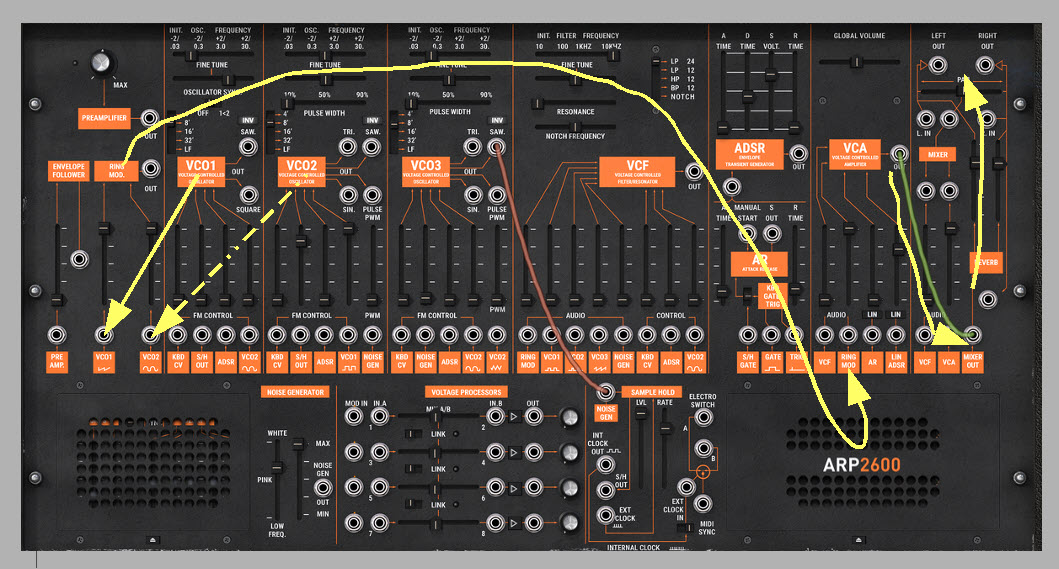
This is another reason to trace the full signal path before predicting how a modulation source will sound. The effect of a square wave depends on what it modulates and where that modulation occurs in the audio system.
Three controls that change the pattern
Once the patch is working, three controls have especially clear effects on its behaviour.
1. Oscillator 3 frequency: changing the pattern
Oscillator 3 supplies the sawtooth waveform that Sample & Hold samples.
Changing Oscillator 3's frequency changes the waveform's phase relationship with the sampling instants. Even if the Sample & Hold rate remains constant, the unit may capture different voltage values at each sampling moment.
The resulting pitch sequence can therefore change without changing the sampling rate itself.
This is a good example of how two independent timing relationships can interact to produce a changing pattern.
2. Oscillator 1 frequency: changing the speed of the pitch pattern
Oscillator 1's square wave modulates Oscillator 2's pitch. Its frequency determines how quickly those modulation changes occur.
Because Oscillator 2 is one of the ring modulator's inputs, changing its frequency changes the ring-modulator output as well. In this patch, Oscillator 1's frequency therefore has an important influence on the speed of the audible pattern.
This is distinct from the Sample & Hold rate. The Sample & Hold determines how frequently it captures new control-voltage values, while Oscillator 1 contributes another rate of change through its modulation of Oscillator 2.
3. Sample & Hold Rate: changing the raindrop rate
The Sample & Hold Rate control determines how often a new voltage is sampled and held.
Increasing the rate makes the control-voltage sequence change more frequently. Decreasing it makes the sequence change more slowly.
This is the most direct control for changing the rate at which new Sample & Hold values appear, though the overall musical pattern also depends on the other oscillator and modulation settings.
Why the patch is more than a random sequence
At first glance, Prancing Raindrops may seem like a random-pitch generator. But its behaviour is more interesting than simply feeding random voltage into an oscillator.
The Sample & Hold captures voltage from a sawtooth waveform. Oscillator 3's frequency influences which voltage values are sampled. Oscillator 1 modulates Oscillator 2, and Oscillator 2 interacts with Oscillator 1 through the ring modulator. Meanwhile, the Sample & Hold's internal trigger helps activate the envelope system.
The result emerges from several interacting processes operating at different rates.
This is a basic but powerful approach to generative music: rather than specifying every note and every event, we construct a system whose internal relationships produce ongoing variation.
The pattern is not necessarily unpredictable in every respect. Its behaviour is constrained by oscillator frequencies, sampling rate, waveform shape and modulation depth. Changing one of those elements changes the relationships within the system.
What Prancing Raindrops teaches us
This patch demonstrates several principles that are useful far beyond the ARP 2600:
- Ring modulation creates new spectral components. It is not the same as mixing two oscillators.
- Sample & Hold turns a changing input voltage into a sequence of held values. The source and sampling rate determine the character of the sequence.
- Audio and control-voltage paths must be traced separately. A module can affect the sound without its direct audio output being audible.
- Internal triggers can make a patch self-running. An envelope does not always have to depend on a keyboard gate.
- Interactions between different rates create evolving patterns. Changing one oscillator's frequency can alter the sequence even when the Sample & Hold rate stays the same.
Prancing Raindrops is a valuable lesson in thinking of a synthesizer as an interconnected system. The most interesting part of the patch is not any one module, but the relationships between them.
Once we understand those relationships, the patch stops being a mysterious collection of cables and becomes a set of understandable processes that we can analyse, modify and use in our own music.
Just click here to watch this patch analysis as a video on YoutTube.
Related articles
Tags - Knowledge Base
- ARP 2600
- ARP 2600 Patch Book
- ARP 2600 Patches
- Prancing Raindrops
- ring modulation
- ring modulator
- Sample and Hold
- S&H
- random voltage
- analog synthesizer
- oscillator cross-modulation
- square wave modulation
- Generative Music
- self-running synthesizer patch
- Voltage Control
- VCO
- VCA
- ADSR
- AR envelope
- electronic music
- Modular Synthesis