
Composing with Randomness: 5 Principles for Generative Music
How Can You Combine Randomness, Motion and Structure When Composing Generative Music?
Composing with Randomness: Five Principles for Generative Music
Practical Strategies for Balancing Randomness, Motion, Variety and Structure
Randomness is one of the most fascinating resources available to composers working with modular synthesizers.
It allows us to create events that we couldn't easily have conceived ourselves, to escape familiar musical habits and to develop systems that produce different results with every performance.
Just click here to get more details about this topic, including graphs, presets, patches and videos.
But unrestricted randomness is rarely sufficient to create compelling musical compositions.
The real challenge is to establish a productive relationship between unpredictable events and compositional organisation.
Over the years, I have developed several practical principles that help me approach this challenge. They are not rigid rules, but useful guidelines for designing generative systems that remain interesting over longer periods of time.
1. More Variety Within Motion Requires Less Additional Structure
A motion already establishes a relationship between different events.
Imagine an ascending sequence of randomly selected pitches. The individual pitches can vary considerably, but their general direction remains recognisable.
Because the motion itself provides a degree of organisation, we don't necessarily need to impose an additional complex structure on the process.
The more variety is presented within a perceivable motion, the less additional structure may be required.
This doesn't mean that structure becomes unnecessary. Rather, the directional development already provides the listener with something to follow.
In modular synthesis, this can be achieved by combining random voltage generation with an ascending or descending constraint, a voltage offset that changes over time, or a sequencer that gradually shifts the available pitch range.
The result can remain unpredictable while retaining a clear overall direction.
2. The More Randomness, the More Important Structure Becomes
The opposite situation requires a different approach.
Imagine several random generators controlling pitch, rhythm, amplitude and timbre simultaneously.
Every parameter changes independently, and there is no clear directional development.
Such a system can produce an enormous variety of sonic events. But it can also become difficult for the listener to recognise relationships between them.
The more randomness we introduce, the more important structure becomes.
A regular clock, a recurring rhythmic pattern, a defined sequence of sections or a recurring timbral element can provide a framework for otherwise unpredictable events.
For example, random pitches can be organised into groups of seven notes, followed by a pause. Random timbral changes might occur only at the beginning of each new group.
The individual events remain unpredictable, but the overall organisation becomes recognisable.
Structure gives randomness a context.
3. Apply Motion and Randomness to Different Sonic Parameters
One of the most useful strategies is to apply motion and randomness to different sonic parameters simultaneously.
For example:
- Randomness controls pitch.
- Motion controls filter cutoff frequency.
- A structured clock pattern determines rhythmic organisation.
- A stochastic process controls the duration of individual events.
This creates several independent layers of behaviour.
The pitch can remain unpredictable while the timbre gradually develops. The rhythmic structure can provide continuity while the melodic material changes.
An especially interesting result occurs when these independent developments interact perceptually.
A steadily opening filter, for example, gradually changes the character of randomly generated pitches. The filter motion doesn't eliminate the randomness of the pitch generator, but it changes the way the resulting notes are heard.
This approach is particularly powerful in modular synthesis because almost every relevant sonic parameter can be controlled independently.
It also prevents a common problem: applying too many competing random processes to the same parameter and losing any sense of meaningful development.
4. Strong Stochastic Tendencies Can Reduce the Need for Explicit Structure
Not every stochastic process requires a clearly defined additional structure.
Imagine a random generator with a very strong preference for certain events.
One pitch might have a probability of 70%, while several other pitches share the remaining 30%.
Although the resulting sequence remains unpredictable, it develops a recognisable statistical character.
The listener may perceive a tendency towards a certain pitch, register or rhythmic event.
The stronger the differences between the probabilities of individual events, the less additional structural organisation may be necessary.
This is particularly interesting when creating generative musical material that should feel organic rather than mechanically repetitive.
However, probability distributions alone don't guarantee a meaningful composition. They establish tendencies, not necessarily musical development.
A stochastic process can still benefit considerably from an overarching structure.
5. Multiple Simultaneous Motions Can Substitute for Structure
An especially interesting possibility arises when several motions operate simultaneously but affect different sonic parameters.
Imagine the following developments:
- Pitch gradually moves upwards.
- Filter cutoff gradually decreases.
- Rhythmic density increases.
- Reverb decay becomes progressively longer.
Each parameter follows its own direction.
Individually, these motions are relatively simple. Together, however, they create a much more complex sonic development.
The interaction between them can establish a perceptible sense of organisation without requiring an additional, explicitly defined structure.
In other words, several simultaneous motions can take over some of the organisational functions normally associated with structure.
This can work for quite a long time, especially when the different motions develop at different speeds.
It is important, however, to avoid confusing simultaneous movement with meaningful development. If all parameters simply move in predictable directions without any interesting interaction, the result can become monotonous again.
The compositional potential lies in the relationships between the motions.
6. A Practical Strategy: Composing with Clusters of Sonic Developments
The five principles above provide a theoretical foundation. But how can we translate them into a practical compositional technique?
One method I use quite frequently is to create several clusters of different types of sonic development.
Instead of beginning with a complete generative patch, I first prepare collections of possible behaviours.
For example:
Cluster 1: Directional motions
This cluster contains developments that follow a recognisable direction.
Examples:
- Increasing pitch.
- Decreasing pitch.
- Increasing rhythmic density.
- Gradually opening filters.
- Progressively increasing spectral complexity.
Cluster 2: Completely random developments
This cluster contains processes without an intentional directional tendency.
Examples:
- Random pitch selection.
- Random amplitude changes.
- Random selection of different timbres.
- Randomised event durations.
Cluster 3: Strongly stochastic developments
This cluster contains processes with clearly differentiated probabilities.
Examples:
- A pitch with a high probability of occurrence and several less likely alternatives.
- Rhythmic events with strongly unequal probabilities.
- Random selection between timbral variations with different weighting.
The exact contents of the clusters aren't important. What matters is that each cluster represents a different general character of sonic behaviour.
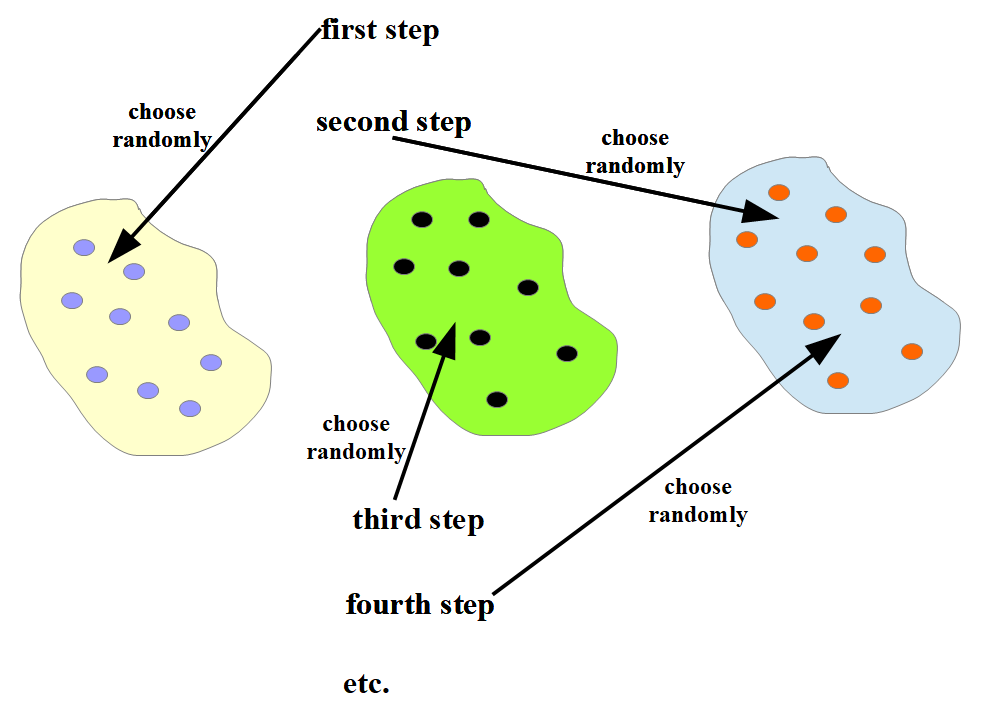
Organising the Clusters
Once the clusters have been created, I establish an order in which examples are selected from them.
For instance:
- Select one development from Cluster 1.
- Select one development from Cluster 3.
- Select one development from Cluster 2.
- Select another development from Cluster 3.
- Select another development from Cluster 1.
- Repeat the process with a different order.
The selection within each cluster can itself be random.
This means that the resulting sequence of developments contains two levels of organisation:
- The selection of a particular cluster follows a defined structure.
- The selection of an individual development within that cluster remains unpredictable.
The structure is therefore not imposed directly on every sonic event. Instead, it organises the selection of different types of behaviour.
Applying the Developments to Sonic Parameters
The next step is to apply the selected developments to different sonic parameters.
A directional motion might control filter cutoff, a random process might control pitch, and a stochastic development might determine rhythmic density.
The possibilities are numerous.
What makes this technique particularly interesting is that it allows us to combine different kinds of sonic behaviour without having to design one enormous, rigid system from the beginning.
We are effectively composing with collections of possible developments.
An Alternative: Assigning Developments to Parameters in Advance
Sometimes I modify this strategy by assigning individual developments to particular sonic parameters directly within their respective clusters.
For example:
- The pitch-related developments are collected in one group.
- The timbral developments are collected in another.
- Rhythmic developments form a third group.
This reduces flexibility because the developments are no longer freely interchangeable between parameters.
On the other hand, it makes the actual patching process considerably easier and can be particularly useful when working with large generative systems.
7. Why This Strategy Is Useful
The cluster approach offers several advantages.
First, it separates the compositional decision of what kind of development should occur from the technical question of how to implement that development.
Second, it makes it easier to combine different types of randomness and motion without losing control of the overall organisation.
Third, it allows us to create systems that are both unpredictable and structurally coherent.
And finally, it encourages us to think in terms of musical behaviour rather than individual modules.
Instead of asking which random generator or sequencer we should connect next, we begin by asking what kind of sonic development we want to introduce.
The technical implementation follows from the compositional intention.
Conclusion: Randomness as a Compositional Resource
Randomness is not the enemy of structure, and structure doesn't have to eliminate unpredictability.
The most productive generative systems often combine several different types of behaviour: directional motion, random variation, probability-weighted events and recurring organisational principles.
The five guidelines discussed here are intended to help find a balance between these elements.
The cluster-based technique provides one practical way of putting them into action.
Ultimately, the purpose of all these strategies is not to make a patch more complicated. It is to create a generative system capable of producing sonic developments that remain interesting, coherent and musically meaningful.
Just click here to get more details about this topic, including graphs, presets, patches and videos.