
Variety, Randomness, Motion and Structure in Generative Music
What Are Variety, Randomness, Motion and Structure in Generative Music?
Variety, Randomness, Motion and Structure in Generative Music
Understanding Four Fundamental Concepts of Generative Composition
Generative music is often associated with randomness, unpredictability and continuously changing sonic events. Modular synthesizers, probability-based sequencers, random voltage generators and stochastic processes offer seemingly endless possibilities for creating variations. But there is an important distinction between generating different sounds and creating an interesting musical composition.
Just click here to get more details about this topic, including graphs, presets, patches and videos.
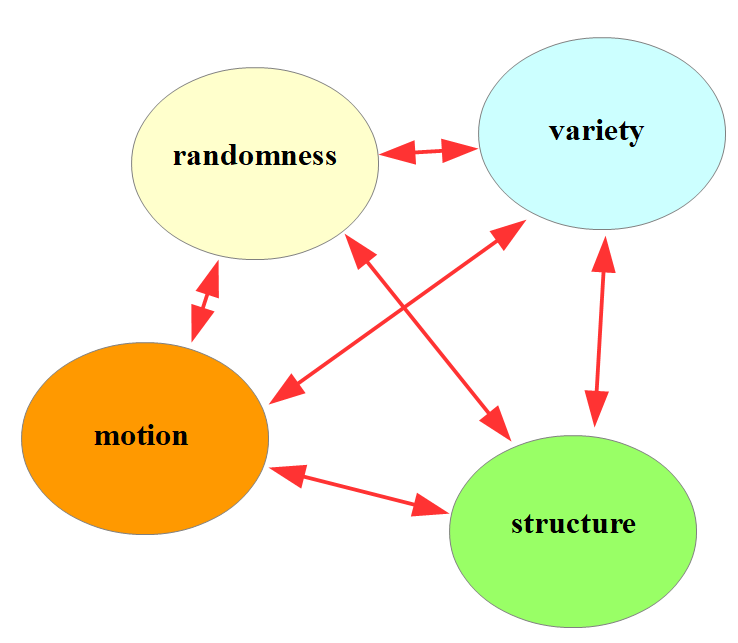
To understand this distinction, we need to look more closely at four fundamental concepts: variety, randomness, motion and structure. Although these terms are sometimes used interchangeably in discussions about generative music, they describe different phenomena. Understanding their relationships is essential when designing generative systems that produce coherent, evolving and musically meaningful results.
1. Variety: Difference Is Not Necessarily Randomness
Variety simply means the presence of different sonic events, values or characteristics.
A composed melody contains variety because it consists of different pitches. However, these pitches don't have to be random. A carefully written melody can deliver considerable variety while remaining entirely predictable in its construction.
The opposite is also possible. Imagine a random voltage generator producing an endless succession of different pitches. Technically, there is considerable variety. Yet after some time, the succession may begin to sound monotonous.
This apparent contradiction is important: variety alone doesn't guarantee musical interest.
The listener doesn't necessarily perceive an endless succession of different events as meaningful development. Without relationships between those events, variety can become little more than an accumulation of unrelated sonic occurrences.
In generative composition, the challenge is therefore not simply to produce differences but to organise them in ways that create musical relationships.
2. Randomness and Stochastic Processes
In my terminology, I distinguish between completely random, limited random and stochastic processes.
A process is completely random when all technically possible next events have equal probabilities of occurrence. Predicting the next event is therefore essentially equivalent to guessing a lottery number.
A limited random process excludes certain possibilities. It reduces the available selection without necessarily assigning different probabilities to the remaining possibilities. This is a form of tamed randomness.
A stochastic process, on the other hand, assigns different probabilities to different possible events. Some events are more likely to occur than others.
Importantly, a higher probability doesn't tell us exactly when an event will happen.
For example, a random generator might produce five different pitches with the following probabilities:
- C: 50%
- D: 25%
- E: 15%
- G: 7%
- B: 3%
C will occur more frequently in the long run, but there is no guarantee that it will be the next note. Nor does its higher probability tell us when it will occur again.
Stochastic processes can therefore be completely random or limited random in terms of their possible outcomes, while also introducing probability weighting.
This distinction is particularly useful in modular synthesis. It allows us to move beyond the simple choice between predictable sequences and unrestricted randomness.
3. Motion: Directed Sonic Development
In conventional music theory, the term motion is primarily associated with the movement of pitches, particularly melodic movement.
For generative music and sound design, I use a considerably broader definition.
A sonic motion is any perceivable development that moves in a certain direction.
This direction doesn't have to be related to pitch. It can involve practically any sonic parameter.
Consider these examples:
- A filter cutoff frequency gradually increases.
- A sound develops from a simple sine wave into a complex spectrum containing progressively more partials.
- The density of sonic events increases over time.
- Repetitions become progressively shorter.
- The amplitude of successive events gradually decreases.
- A stereo signal moves slowly from left to right.
- A rhythmic pattern gradually changes from regular to increasingly irregular subdivisions.
All these developments represent motion because they have a perceivable direction.
Of course, a motion can change direction. A filter can open and subsequently close, rhythmic density can increase and then decrease, and a melodic development can reverse its direction.
The important characteristic is that the development is directed rather than merely changing without any discernible tendency.
This extended understanding of motion is particularly important for modular synthesis. It allows us to create musical development through several independent dimensions of sound rather than relying exclusively on melodies and conventional harmonic progressions.
4. Structure: Organising Sonic Events
Structure describes a particular and perceivable way of organising sonic events.
It can establish relationships, repetitions, hierarchies and distinctions between different sections or elements of a composition.
For example, imagine a sequence consisting of five notes:
C4 – D4 – E4 – F4 – G4
Now repeat the same five-note pattern, but start each repetition three semitones higher than the previous one:
C4 – D4 – E4 – F4 – G4
Eb4 – F4 – G4 – Ab4 – Bb4
F#4 – G#4 – A#4 – B4 – C#5
We have established a structure through repetition and transposition. At the same time, this structure creates an upward motion.
However, structure doesn't necessarily create motion.
If the same five-note pattern starts at different pitches without following a consistent direction, we still have a recognisable structure of repetition, but no necessarily perceivable overall upward or downward development.
Structure and motion are therefore related, but they are not identical.
5. How the Four Concepts Influence Each Other
Understanding the individual concepts is only the beginning. Their relationships are much more interesting from a compositional perspective.
Motion and randomness
Motion imposes directional limitations on randomness. It acts as a kind of probability mask, excluding or reducing the likelihood of events that contradict the intended direction.
An upward-moving pitch process, for example, can still contain random pitch selections, but the available possibilities are restricted by the requirement to move upwards.
Motion and variety
Motion doesn't necessarily reduce variety. An ascending scale contains different pitches, but all these pitches contribute to one coherent direction.
A motion can therefore provide a relationship between different events without making them identical or repetitive.
Structure and variety
Structure sometimes reduces variety, but not always.
A repeated sequence with progressively higher starting pitches restricts the available possibilities. On the other hand, a structure consisting of several completely different sonic sections can organise considerable variety without reducing it.
The effect depends entirely on the type of structure being applied.
Structure and randomness
Structure limits randomness only when both operate on the same sonic parameter.
For example, a strictly organised pitch sequence directly limits random pitch generation.
But imagine combining random pitch selection with a filter cutoff frequency that follows a carefully composed development. The filter structure doesn't eliminate or reduce the randomness of the pitch selection. It simply influences how those pitches are perceived.
A low note played through an almost closed low-pass filter and a high note played through the same filter can produce very different perceptual results from what their pitches alone might suggest.
This distinction opens up a particularly interesting field of possibilities: organising one sonic dimension while allowing another to remain unpredictable.
Conclusion: Beyond Random Sound Generation
Variety, randomness, motion and structure are not interchangeable concepts. They describe different ways of generating, organising and developing sonic events.
Their relationships offer us considerably more compositional possibilities than randomness alone.
A generative patch can produce an enormous number of different events and still remain musically uninteresting. Conversely, a relatively simple system can produce compelling results when its events are organised into meaningful relationships.
The real challenge of generative composition is therefore not to generate as much material as possible. It is to establish relationships between sonic events that make the resulting development interesting, recognisable and musically convincing.
This is where the compositional thinking begins.
Just click here to get more details about this topic, including graphs, presets, patches and videos.