Controlling the Duration of Pitch Events with Multiple Clock Sources
How Can Pitch Glitches Be Shorter Than the Main Melody?
Controlling the Duration of Pitch Events with Multiple Clock Sources
Generative systems often focus on pitch selection.
Yet the duration of events can be equally important.
The chapter demonstrates a clever technique for controlling how long different melodic behaviours remain active.
Two Clocks, Two Behaviours
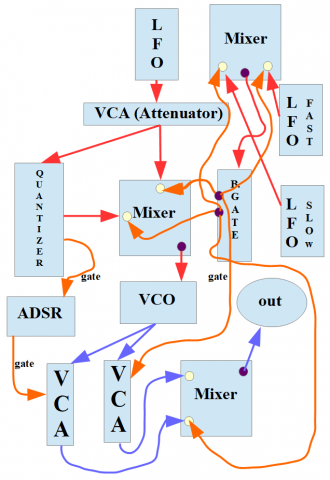
The patch introduces a second clock source.
The original clock runs slowly.
A second clock operates at a higher frequency.
A mixer and a Bernoulli gate determine which clock currently controls the system.
Long Melodies and Short Glitches
When the Bernoulli gate selects the quantized melody path, the slower clock remains active.
As a result, melodic phrases continue for relatively long periods.
When the gate selects the glitch path, the faster clock becomes active.
The system quickly reevaluates its state and returns to the melody.
This causes pitch glitches to become short-lived events.
Musical Consequences
The listener experiences:
stable melodic regions,
brief interruptions,
- rapid returns to order.
This creates a strong sense of hierarchy within the music.
Beyond Pitch
The same concept can be applied to:
rhythm,
timbre,
modulation routing,
- effect processing.
Different behaviours can be assigned different temporal scales.
Conclusion
Controlling the duration of states is often more important than controlling the states themselves. Multiple clocks provide an elegant method for shaping how long musical events remain active.
Just click here to get more details about this topic, including graphs, presets, patches and videos.