Probability Gates: Randomly Activating Events in Modular Synthesis
What Are Probability Gates and How Can They Be Used in Generative Music?
Probability Gates: Randomly Activating Events in Modular Synthesis
Probability gates are among the simplest and most useful tools for introducing uncertainty into a modular patch.
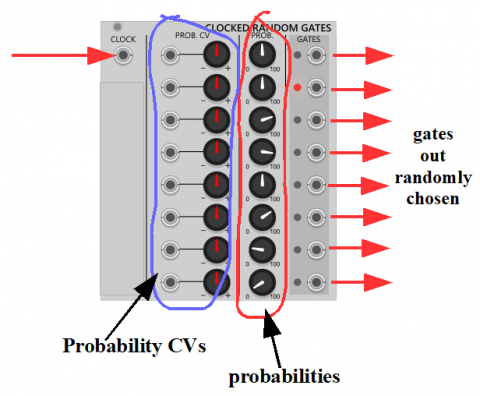
Their operation is straightforward: every incoming clock pulse creates an opportunity for a gate to open—or not.
How Probability Gates Work
Each gate output has its own probability setting.
When a clock pulse arrives:
some outputs may activate,
- some may remain inactive.
The outcome is determined probabilistically.
Single and Multimode Operation
Some modules offer two operating modes.
In multimode, several outputs may become active simultaneously.
In single mode, only one output activates per clock pulse.
Creative Applications
Probability gates can:
activate voices,
enable modulation paths,
switch processing chains,
create evolving arrangements,
- route signals dynamically.
Why They Matter
Unlike sequencers, probability gates do not create content directly.
Instead, they decide which existing processes become audible or active.
This makes them ideal structural tools.
Conclusion
Probability gates add uncertainty to a patch without forcing changes to the underlying musical material. They are powerful tools for creating evolving modular ecosystems.
Just click here to get more details about this topic, including graphs, presets, patches and videos.