Gray Code Modules: Creating Perfect Pseudo-Random Trigger Patterns
How Do Gray Code Modules Generate Apparently Random Sequences?
Gray Code Modules: Creating Perfect Pseudo-Random Trigger Patterns
Not every apparently random musical process is actually random.
Some systems produce results that sound highly unpredictable while following strict mathematical rules. Gray Code modules belong to this category.
For generative musicians, they are fascinating because they create trigger and gate patterns that often feel random despite being entirely deterministic.
What Is Gray Code?
Gray Code is a binary counting system developed by physicist Frank Gray.
Unlike ordinary binary counting, each consecutive number differs from the previous one by only a single bit.
This seemingly small difference creates a unique pattern of gate activity when Gray Code is translated into modular signals.
How a Gray Code Module Works
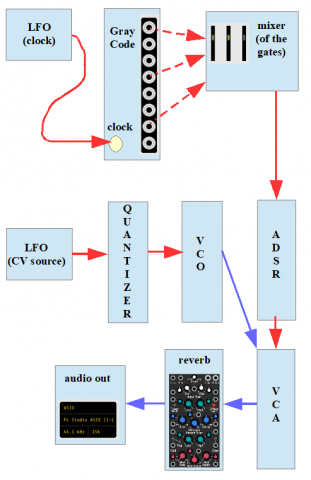
Imagine a module with eight outputs.
Each output represents one bit of the Gray Code count.
As the counter advances, outputs switch between low and high states according to the Gray Code sequence.
The resulting gate patterns appear highly irregular even though they are completely predetermined.
Why It Sounds Random
The gate streams generated by the outputs do not follow obvious rhythmic patterns.
Some outputs change frequently.
Others remain high or low for extended periods.
When several outputs are combined, the resulting behaviour can easily be mistaken for randomness.
Musical Applications
Gray Code outputs can be used to:
trigger envelopes,
activate voices,
switch modulation paths,
create rhythmic structures,
- generate pseudo-random gate networks.
Because the outputs are binary, they are most useful for timing and event generation rather than direct pitch generation.
Conclusion
Gray Code modules demonstrate that unpredictability does not require randomness. Carefully designed deterministic systems can create musical behaviour that feels remarkably random while remaining completely repeatable.
Just click here to get more details about this topic, including graphs, presets, patches and videos.