Shift Registers with Feedback: Creating Repeating Generative Patterns
How Can Shift Registers Generate Repeating Yet Unpredictable Sequences?
Shift Registers with Feedback: Creating Repeating Generative Patterns
Few modules appear less suited to creating regular cycles than shift registers.
Yet with a small modification they become remarkably effective generators of repeating but initially unpredictable patterns.
How a Shift Register Works
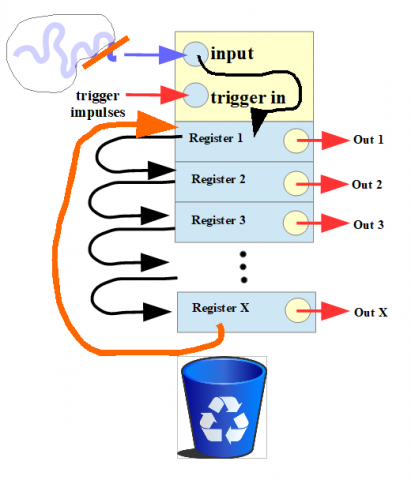
Whenever a trigger arrives, a shift register samples an incoming voltage.
The newest value occupies the first position.
Existing values move one step further along the register.
The oldest value eventually leaves the system.
Turning Randomness into Regularity
To create a repeating cycle, two conditions must be met:
The final register output must be fed back into the first register.
- New external samples must eventually stop entering the system.
Once these conditions are satisfied, the stored pattern circulates endlessly through the register.
Why This Is Interesting
Initially, the content of the register may be unpredictable.
After initialization, however, the sequence becomes perfectly repeatable. The pattern is unknown beforehand, but once established it behaves as a regular cycle.
This creates a fascinating middle ground between randomness and order.
Multiple Outputs
Most shift registers provide several outputs.
Each output contains a different stage of the circulating pattern.
These outputs can simultaneously control:
multiple oscillators,
filter banks,
effect networks,
- polyphonic voices.
Conclusion
Feedback transforms a shift register from a memory device into a generative engine. The resulting patterns combine surprise and stability in a way that perfectly suits generative composition.
Click here to read more about the topic including graphics, presets, patches and videos.