Sequential Switches: Building Complex Cyclic Waveforms from Multiple Sources
How Can Sequential Switches Create New Generative Modulation Patterns?
Sequential Switches: Building Complex Cyclic Waveforms from Multiple Sources
At first glance, a sequential switch appears to be little more than a routing utility.
Its purpose seems simple: connect several inputs to one output, or one input to several outputs, and move through these connections step by step.
Yet in generative music, sequential switches can become surprisingly powerful tools for creating complex cyclic behaviour.
What Is a Sequential Switch?
A sequential switch changes signal paths whenever it receives a trigger or clock pulse.
For example:
Input 1 is connected to the output.
The next trigger connects Input 2.
The following trigger connects Input 3.
- Eventually the cycle returns to Input 1.
The process repeats indefinitely.
Combining Multiple Modulation Sources
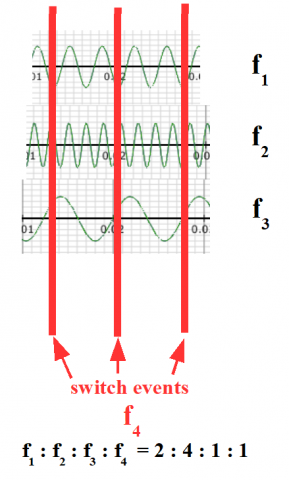
Imagine four different LFOs.
Each produces a unique waveform.
A sequential switch can select one waveform after another.
The resulting output is no longer a simple LFO.
Instead, it becomes a composite modulation signal assembled from multiple sources.
Creating Larger Cycles
One important observation from the book is that the length of the resulting cycle depends on both:
the cycle lengths of the individual modulation sources,
- the switching pattern itself.
This means extremely long composite cycles can emerge from relatively simple building blocks.
Musical Applications
Sequential switches can create:
evolving modulation curves,
changing melodies,
rotating timbral structures,
rhythmic variation,
- multi-stage generative processes.
A switch effectively becomes a conductor deciding which modulation source is active at any given moment.
Sequential Switches as Structural Devices
Many generative patches focus on creating variation.
Sequential switches add another dimension: structure.
They allow modulation sources to appear, disappear, and return according to predetermined or evolving patterns.
This can create the impression of musical sections within a continuously running patch.
Conclusion
Sequential switches demonstrate a recurring principle of generative music: complexity often emerges from interactions rather than from individual modules. By combining several simple modulation sources, a sequential switch can create rich cyclic structures that evolve over long periods of time.
Click here to read more about the topic including graphics, presets, patches and videos.