Using Sequencers as Cyclic Control Voltage Generators
Can a Sequencer Function as an LFO in Generative Music?
Using Sequencers as Cyclic Control Voltage Generators
Most musicians think of sequencers as note generators.
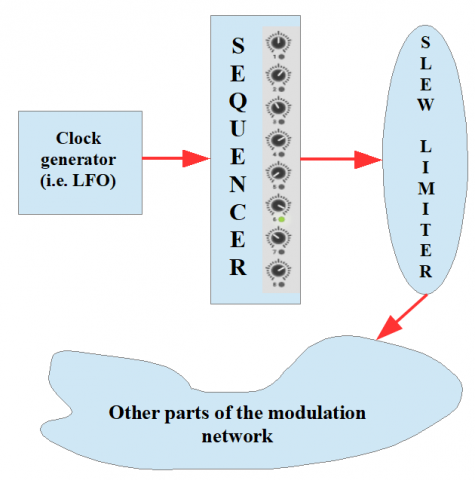
Yet a sequencer is fundamentally a device that outputs a repeating sequence of voltages. Viewed from this perspective, it becomes an excellent source of cyclic control voltage.
The book introduces sequencers as tools for sculpting complex repeating CV shapes rather than merely generating melodies.
Beyond Notes
Every step in a sequencer represents a voltage level.
If these voltages are routed to:
filter cutoff,
effect parameters,
modulation depth,
- wave shaping,
the sequencer becomes a modulation source rather than a melodic source.
Creating Complex Waveforms
A sequencer can create waveforms that would be difficult to obtain from ordinary LFOs.
Each step acts as a manually programmable point in a control-voltage curve.
The resulting shape can be:
smooth,
stepped,
symmetrical,
asymmetrical,
periodic,
- irregular.
The Role of Slew Limiters
Without additional processing, sequencer voltages change abruptly.
A slew limiter smooths these transitions.
The resulting signal can resemble a custom-designed LFO waveform while retaining the programmability of a sequencer.
Why Sequencers Matter in Generative Music
Generative music often depends on creating complex but repeatable structures.
Sequencers provide an efficient way to design those structures intentionally while still allowing them to interact with other modulation sources.
Conclusion
A sequencer is not merely a note-producing device. It can become a sophisticated source of cyclic modulation capable of generating custom control-voltage shapes that extend far beyond traditional LFO behaviour.
Click here to read more about the topic including graphics, presets, patches and videos.