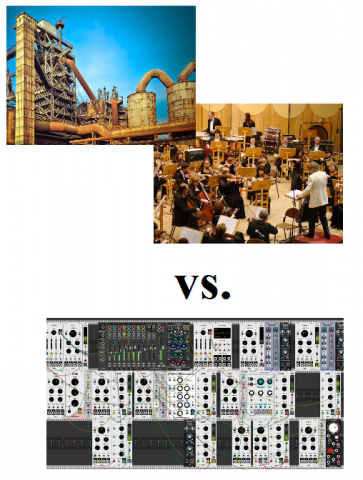
Creating Contrast in Generative Music
How Do You Create Contrast in Generative Music?
Creating Contrast in Generative Music
Contrast is one of the oldest compositional tools in music. Long before modular synthesis, composers created interest by placing opposing musical ideas next to one another.
Generative music is no exception.
While the methods may differ, the goal remains the same: keeping the listener engaged through meaningful differences between musical events.
Why Contrast Matters
Without contrast, even beautiful sounds can become predictable.
A listener quickly adapts to any sonic environment. Contrast refreshes attention and creates a sense of movement.
Traditional Forms of Contrast
Many classical methods remain useful in generative music:
Long sounds versus short sounds
Low frequencies versus high frequencies
Dense textures versus sparse textures
One timbral family versus another
Different scales or harmonic environments
- Different envelope shapes
These techniques remain effective whether a piece is fully composed or partially generated.
Contrast Beyond Timbre
Generative systems allow deeper forms of contrast.
A patch may contrast:
Stability and randomness
Predictability and surprise
Structured melody and free pitch movement
- Organic and artificial sound sources
These contrasts often become more important than traditional harmonic contrasts.
Contrast as Structure
Rather than thinking of contrast as decoration, it can become a structural principle.
Entire sections of a generative piece may be defined by contrasting behaviours.
One section may be highly predictable while another becomes increasingly autonomous.
Conclusion
Contrast remains one of the most powerful compositional tools available to generative musicians. The difference is that modern systems allow contrast to emerge not only from sounds themselves, but from the behaviours that create those sounds.
Just click here to get more details about this topic, including graphs, presets, patches and videos.