Envelope Modulation and Randomization in Modular Synthesis
How Do Attack, Decay and Release Modulations Affect Envelopes?
Envelope Modulation and Randomization in Modular Synthesis
Envelopes are commonly viewed as modulation sources.
They can also become modulation targets.
This distinction is important because envelope parameters behave differently from many other synthesizer controls.
Why Envelope Modulation Is Unique
Parameters such as attack, decay, and release describe time.
Time behaves differently from pitch, timbre, or level.
Once part of an envelope phase has already occurred, that portion cannot be restored.
This creates asymmetrical behaviour when envelope parameters are modulated during execution.
Modulating Attack Time
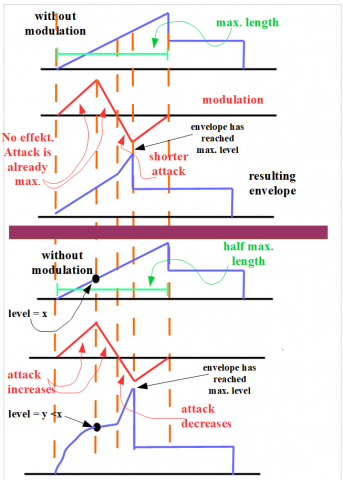
Consider an attack stage whose duration is continuously changing.
A falling control voltage shortens the remaining attack.
A rising control voltage can only influence the portion of the attack that has not yet occurred.
As a result, attack modulation tends to shorten the effective attack time compared to an unmodulated envelope.
Similar Behaviour in Decay and Release
The same principle applies to:
decay,
- release.
The envelope can only react to changes that occur before the phase has completed.
This limits the dramatic impact of such modulation.
Why Envelope Modulation Often Sounds Subtle
Because of these timing constraints, attack, decay, and release modulation typically create nuanced variations rather than radical transformations.
These subtle changes can nevertheless contribute significantly to long-term musical development.
Conclusion
Envelope modulation behaves differently from most synthesizer modulation targets because it operates on time itself. Understanding this behaviour helps create more predictable and musically useful results.
Just click here to get more details about this topic, including graphs, presets, patches and videos.