Quantizer Modulation and Generative Harmony
How Can Quantizers Change Scale and Key Automatically?
Quantizer Modulation and Generative Harmony
Many musicians think of quantizers as simple pitch-correction devices.
In generative music they can become active harmonic processors.
Modern quantizers often allow scale and key selection through control voltages, opening the door to continuously evolving harmonic systems.
Modulating Scale and Key
A useful strategy is to treat scale and key differently.
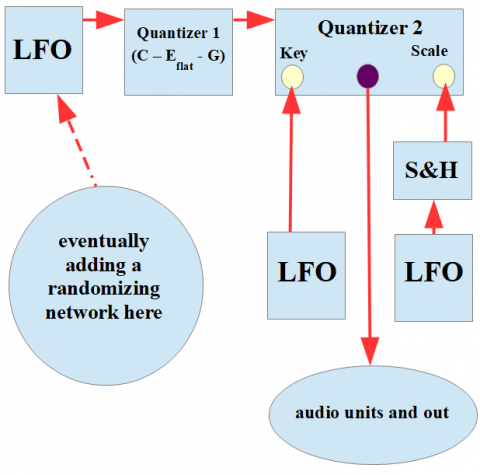
The chapter suggests allowing one parameter to change randomly while the other follows a repeating modulation pattern.
This creates a balance between predictability and surprise.
The listener can still recognize harmonic relationships while the music continues evolving.
Using Two Quantizers
An especially powerful technique involves placing one quantizer before another.
The first quantizer restricts pitches to a small set, such as the notes of a chord.
The second quantizer changes scale or key.
This hierarchy makes harmonic changes easier to perceive.
Preserving Musical Coherence
Without restrictions, continuous scale and key changes can become difficult to follow.
Constraining the available pitches before transposition helps maintain recognizable musical relationships.
Integer Frequency Relationships
The chapter also points out an interesting observation.
When repeating modulation cycles operate at integer-related frequencies, the resulting harmonic movement often sounds surprisingly familiar.
The music may retain a recognizable tonal character while still producing unexpected harmonic shifts.
Conclusion
Quantizer modulation transforms pitch correction into harmonic composition. By controlling scale and key dynamically, quantizers become powerful tools for creating evolving generative harmony.
Just click here to get more details about this topic, including graphs, presets, patches and videos.