Generating Counterpoint from a Single LFO
How Can One LFO Generate Two Contrasting Melodies?
Generating Counterpoint from a Single LFO
A single modulation source can often produce more musical material than expected.
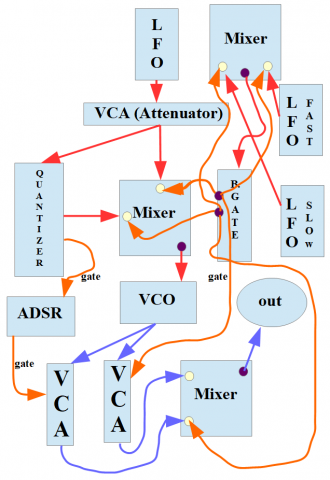
The chapter demonstrates this principle by deriving two complementary pitch streams from different outputs of the same LFO.
Using Two Outputs from One Source
A triangle wave and a square wave are taken from the same LFO.
The square wave is inverted and routed into a second quantizer.
Both quantizer outputs are then combined.
Because the square wave changes state according to the phase of the triangle wave, the resulting melodic behaviour becomes highly structured.
Alternating Activity
When the triangle wave rises, one melodic component dominates.
When it falls, the other component becomes active.
The listener perceives alternating melodic fragments that appear to answer one another.
Why This Feels Like Counterpoint
Traditional counterpoint involves relationships between independent voices.
In this patch, both voices originate from the same modulation source.
Yet the timing relationships create the impression of dialogue.
Musical Benefits
The patch produces:
variation,
internal contrast,
phrase-like behaviour,
- melodic interplay.
All of this emerges from a surprisingly simple architecture.
Conclusion
Counterpoint does not necessarily require multiple independent generators. Carefully exploiting different outputs of a single modulation source can create rich melodic interaction.
Just click here to get more details about this topic, including graphs, presets, patches and videos.