
Five Faces of Randomness in Generative Music
What Are Different Ways to Create Randomness in Modular Generative Music?
Five Faces of Randomness in Generative Music
Randomness is one of the defining characteristics of generative music. However, not all randomness behaves the same way.
A random process can influence:
Pitch
Rhythm
Timing
Timbre
Structure
- Voice allocation
The most interesting generative systems rarely use completely uncontrolled randomness. Instead, they create specific forms of unpredictable behaviour.
This article introduces five practical approaches to generating randomness in modular systems:
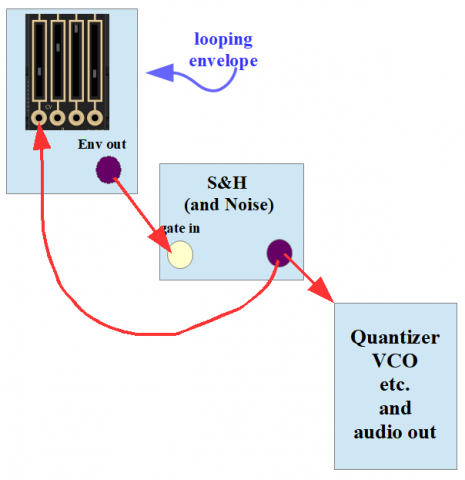
Looping envelopes with Sample & Hold feedback
Inheritance of randomness
LFO–Sample & Hold feedback
Noise roundabout systems
- Bernoulli gate networks
Each method produces a distinct musical character.
Some create evolving rhythms.
Others create changing timing structures.
Some influence entire voices and arrangements.
Understanding these different approaches allows a composer to choose the type of randomness that best serves a musical goal.
Randomness is not a single technique. It is a family of techniques.
Just click here to get more details about this topic, including graphs, presets, patches and videos.
Related articles
- Creating Random Timing with Looping Envelopes and Sample & Hold Feedback
- The Inheritance of Randomness: Cascading Sample & Hold Modules
- LFO and Sample & Hold Feedback Networks
- Building Noise-Based Randomness Systems in Modular Synthesis
- Using Bernoulli Gate Networks in Generative Music
- Sculpting Randomness and Setting Limits in Modular Synthesis