FM and Phase Modulation in Generative Music
How Should FM Parameters Be Modulated in Generative Patches?
FM and Phase Modulation in Generative Music
Frequency modulation and phase modulation are among the most powerful methods for creating evolving timbres.
They are also among the easiest techniques to push beyond useful limits.
Generative systems therefore benefit from a disciplined approach.
Coordinating Carrier and Modulator
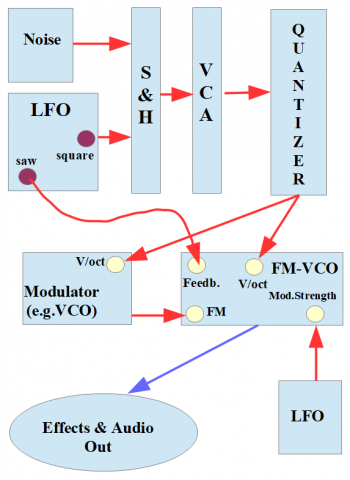
One particularly useful strategy is to modulate the carrier pitch and the modulator frequency together.
When both follow related pitch movements, the resulting timbre tends to remain musically coherent.
Without this relationship, FM spectra can quickly become difficult to control.
The Importance of Modulation Depth
FM depth determines the strength of spectral change.
Small changes often produce subtle colouration.
Large changes can completely transform the sound.
In generative music, moderate settings frequently create more useful long-term results than extreme modulation depths.
Feedback as a Musical Parameter
Many FM oscillators include internal feedback controls.
The chapter points out an interesting observation:
Feedback often sounds more useful when it changes in discrete steps rather than continuously.
Sample-and-hold sources, quantizers, or other stepped modulation generators can therefore be especially effective.
Continuous Versus Discrete Change
Smooth modulation tends to produce gradual timbral movement.
Stepped modulation introduces distinct sonic events.
Both approaches can be useful, but they create very different listening experiences.
Conclusion
Successful generative FM is often less about complexity and more about relationships. Coordinating pitch, modulation frequency, depth, and feedback allows FM systems to evolve while remaining musically meaningful.
Just click here to get more details about this topic, including graphs, presets, patches and videos.