Generative Filter Modulation: Beyond the Classic Filter Sweep
How Can Multiple Modulators Create Evolving Filter Timbres?
Generative Filter Modulation: Beyond the Classic Filter Sweep
Filter modulation is often one of the first techniques people learn in synthesizer programming.
A slowly moving cutoff frequency creates the familiar filter sweep that appears in countless electronic productions.
Generative music, however, offers opportunities that go far beyond this traditional approach.
Thinking Beyond Cutoff Frequency
Many filters provide more than a cutoff control.
Common parameters include:
cutoff frequency,
resonance,
drive or saturation,
filter mode,
- slope.
When several of these parameters are modulated simultaneously, the filter becomes a continuously evolving timbral system rather than a simple tone control.
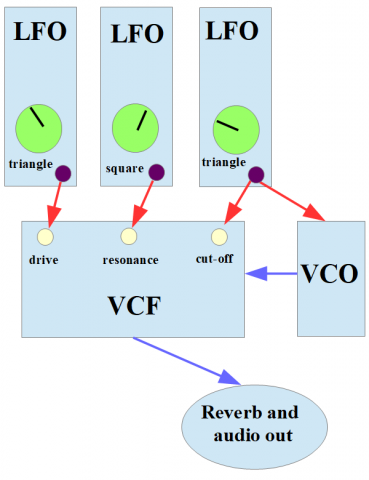
Three Independent Modulators
A particularly effective approach is to assign separate modulation sources to:
cutoff frequency,
resonance,
- drive.
If the modulation sources operate at different frequencies, the resulting interactions create continuously changing sonic relationships.
The chapter demonstrates this idea by using three independent LFOs running at different rates.
Why Asynchronous Modulation Matters
When multiple modulators share the same cycle length, their behaviour quickly becomes repetitive.
Different frequencies generate much longer combined cycles.
The listener perceives a timbre that appears to evolve continuously.
Using Sudden Resonance Changes
The chapter highlights another useful technique.
Instead of smoothly modulating resonance, a square-wave modulation source creates sudden jumps.
This introduces brief sonic accents and transient-like events that stand out from the surrounding texture.
The resulting sounds often resemble water droplets, clicks, or other short spectral events.
Filters as Generative Systems
Many musicians think of filters as processors.
Generative patch design encourages a different perspective.
A filter can become an active participant in musical development.
The evolving interactions between cutoff, resonance, drive, and modulation sources can create a large portion of a composition's movement.
Conclusion
Generative filter design is not about creating a single filter sweep. It is about creating an ecosystem of interacting modulations that continuously reshape the spectral content of a sound.
Just click here to get more details about this topic, including graphs, presets, patches and videos.