
Instruo Harmonàig Explained: Generating Four-Voice Chords from a Single CV
How does Instruo Harmonàig generate four-note chords from one control voltage?
Instruo Harmonàig: Bringing Polyphony into Generative Modular Synthesis
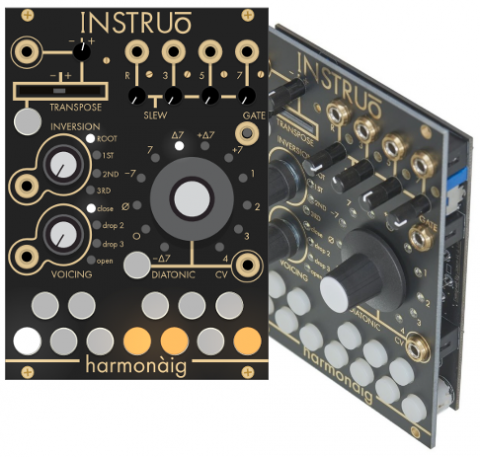
Most quantizers transform an incoming control voltage into a single quantized pitch. Instruo’s Harmonàig takes a different approach. Instead of producing one pitch, it generates an entire chord from a single incoming control voltage.
Available both as a Eurorack module and as a VCV Rack module, Harmonàig is one of the most powerful tools for introducing harmony and polyphony into generative modular systems.
What Does Harmonàig Do?
The core idea is simple:
One pitch CV enters the module.
Harmonàig analyzes that pitch.
- Four related pitch CV outputs are generated.
These outputs correspond to:
Root
Third
Fifth
- Seventh
Together they form a complete four-note chord.
This makes it possible to generate harmonically coherent chord progressions from a single melodic or generative control source.
Operating Modes
Harmonàig offers three primary operating modes:
Unison Mode
Before using the module, it is often useful to enter Unison Mode and tune all outputs identically.
This allows accurate calibration of oscillators and pitch sources.
Quantizer Mode
Quantizer Mode is the primary operating mode for generative music.
Incoming pitch CV is transformed into a four-note chord according to the selected harmonic settings.
Performance Mode
Performance Mode allows the module’s keyboard interface to be played directly.
For generative patching, Quantizer Mode is usually the most important mode.
Understanding the Four Outputs
The four pitch outputs represent harmonic intervals relative to the incoming note.
Root Output
Produces the original incoming pitch.
Third Output
Produces the third of the chord.
Fifth Output
Produces the fifth of the chord.
Seventh Output
Produces the seventh of the chord.
These four outputs can drive four oscillators, four voices, or multiple layers of a polyphonic patch.
Individual Slew Control
Each pitch output includes its own slew control.
This allows each voice to:
Glide independently
Jump instantly between notes
- Move at different rates
The result can be highly expressive harmonic movement rather than rigid block chords.
Transposition Functions
The transpose section allows harmonic movement without changing the incoming control voltage source.
Several operating modes are available:
Octave transposition
Quantized note transposition
- Fine tuning
These functions can be controlled manually or through external CV modulation.
Generative Applications
Harmonàig is especially useful for:
Generative chord progressions
Ambient music
Polyphonic modular patches
Algorithmic harmony generation
Harmonic drone systems
- Evolving chord textures
Instead of building four separate melodic generators, a single CV source can become a complete harmonic structure.
Conclusion
Harmonàig transforms a single pitch stream into a harmonically coherent four-voice chord system. For generative musicians who want to move beyond monophonic sequencing, it offers a remarkably elegant solution.
Just click here to get more details about this topic, including graphs, presets, patches and videos.
Related articles
- Instruo Harmonàig Chord Qualities, Voicings and Inversions Explained
- Scales and Modes in Instruo Harmonàig: Ionian, Dorian, Aeolian and Harmonic Minor
- Mutable Instruments Marbles Deja Vu Explained: Looping, Memory and Controlled Randomness
- Random Harmonic Progressions in Generative Music Using Sequential Switches
- The Turing Machine: Freezing Randomness into Repeating Sequences