
Mutable Instruments Marbles Deja Vu Explained: Looping, Memory and Controlled Randomness
How does the Deja Vu function of Mutable Instruments Marbles work?
Mutable Instruments Marbles Deja Vu Explained
One of the most powerful features of Mutable Instruments Marbles is the Deja Vu system.
Deja Vu allows Marbles to move smoothly between complete randomness and repeatable patterns.
This makes it possible to create generative music that evolves without becoming chaotic.
What Is Deja Vu?
Every time Marbles makes a random decision, it can either:
Generate a completely new decision
Reuse a previous decision
- Rearrange previous decisions
The Deja Vu section controls this behavior.
Separate Deja Vu systems are available for:
The Time Domain
- The CV Domain
They may operate independently.
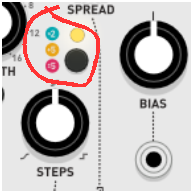
Activating Deja Vu
Deja Vu remains inactive until its corresponding button is enabled.
Once activated, the module begins storing recent decisions and using them as a memory source.
The LENGTH Parameter
The LENGTH control determines how many previous steps are stored.
Typical settings range from:
1 step
- up to 16 steps
The stored sequence becomes the material from which Deja Vu operates.
Deja Vu Knob: Three Regions
Full Counter-Clockwise to Noon
This region gradually reduces randomness.
At the extreme left:
- Every decision is completely new
As the knob approaches noon:
- More stored decisions are reused
At noon:
- The sequence becomes a perfectly repeating loop
No additional randomness is introduced.
Noon Position
This is the fully locked state.
Marbles continuously repeats the stored pattern.
The result resembles a conventional sequencer.
Noon to Full Clockwise
Beyond noon, Marbles begins permuting the stored material.
The same decisions remain available, but their order changes.
This produces variation without introducing entirely new content.
Why Deja Vu Matters
Most random generators force a choice between:
Complete predictability
- Complete randomness
Deja Vu provides a continuum between both extremes.
This allows:
Musical repetition
Gradual evolution
Theme development
- Long-form generative composition
The resulting patches often feel intentional rather than random.
Creative Uses
Deja Vu is particularly useful for:
Ambient music
Generative sequencing
Evolving rhythmic systems
Self-generating performances
Long-duration installations
- Algorithmic composition
A patch can slowly shift between familiarity and surprise while maintaining its overall identity.
Marbles and the Concept of Controlled Randomness
The Deja Vu section embodies one of the central ideas of generative composition:
Randomness becomes musically useful when memory and repetition are introduced.
Instead of generating endless unrelated events, Marbles creates evolving variations of previously established material.
Conclusion
The Deja Vu system is what elevates Marbles from a random source into a true generative composition tool. By controlling memory, repetition and variation, it enables patches that remain interesting over long periods while preserving musical coherence.
Just click here to get more details about this topic, including graphs, presets, patches and videos.
Related articles
- Mutable Instruments Marbles Time Domain Explained: Random Rhythms, Gates and Probability
- Mutable Instruments Marbles CV Domain Explained: Random Voltages, Quantization and Probability
- The Turing Machine: Freezing Randomness into Repeating Sequences
- Using Bernoulli Gate Networks in Generative Music
- Random Harmonic Progressions in Generative Music Using Sequential Switches