
Mutable Instruments Marbles CV Domain Explained: Random Voltages, Quantization and Probability
How does the CV section of Mutable Instruments Marbles generate random voltages?
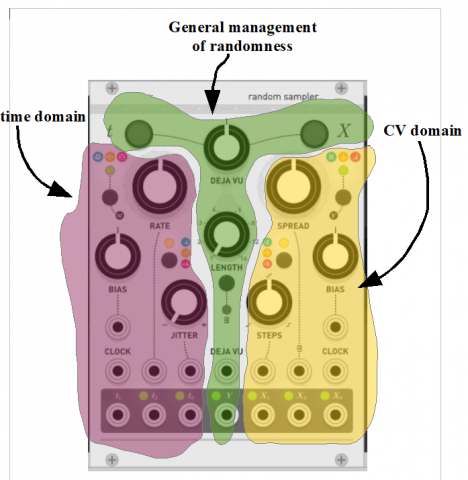
Understanding the CV Domain of Mutable Instruments Marbles
The CV Domain of Mutable Instruments Marbles generates random control voltages for melodies, bass lines, modulation signals and harmonic structures.
Unlike traditional sample-and-hold modules, Marbles offers extensive control over how randomness behaves.
Three Related CV Outputs
Marbles provides three voltage outputs:
X1
X2
- X3
Each output generates random voltages that are related to the rhythmic activity of the Time Domain.
Whenever the corresponding timing output generates a trigger, a new voltage can be produced.
This creates a natural relationship between rhythm and pitch.
Voltage Range Selection
Marbles offers three voltage ranges.
Green Range
0V to +2V
Useful for:
Small melodic movements
Limited modulation ranges
- Narrow pitch distributions
Orange Range
0V to +5V
Useful for:
Wider melodies
- Larger modulation movements
Red Range
-5V to +5V
Useful for:
Full bipolar modulation
Wide melodic spans
- Complex generative patches
SPREAD: Shaping Randomness
SPREAD is one of the most important controls.
With SPREAD centered:
- Voltages follow a bell-curve distribution
Most values occur near the middle of the selected range.
As SPREAD moves left:
- Voltages become increasingly concentrated around the center
Fully left:
- Only the center value appears
As SPREAD moves right:
- Extreme values become increasingly likely
Fully right:
- Only minimum and maximum values occur
The result is effectively a random gate generator.
BIAS: Influencing Probability
Many users misunderstand BIAS.
It does not shift voltages directly.
Instead, it changes the probability of where future voltages are likely to appear.
Turning BIAS right:
- Higher voltages become more likely
Turning BIAS left:
- Lower voltages become more likely
This creates directional tendencies without eliminating randomness.
STEPS: Quantization and Slew
The STEPS parameter performs two different functions.
Counter-Clockwise
Marbles introduces smoothing between values.
The result resembles slew limiting or glide.
Center Position
Standard sample-and-hold behavior.
Clockwise
Quantization begins.
Voltages snap to musical pitches.
Further clockwise movement progressively reduces available notes until only the root note remains across multiple octaves.
This allows Marbles to move smoothly between free random voltages and highly structured musical scales.
Randomness Modes
The CV Domain includes three behavioral modes.
Green Mode
All outputs follow the front-panel settings.
Orange Mode
X2 follows the settings directly.
X1 and X3 generate mirrored variations.
Red Mode
X1 follows the panel settings.
X3 behaves oppositely.
X2 remains neutral.
These modes create related melodic structures without requiring additional modules.
Musical Applications
The CV Domain excels at:
Generative melodies
Random bass lines
Evolving harmonic movement
Modulation generation
Self-generating ambient music
- Controlled aleatoric composition
Conclusion
The CV Domain is much more than a random voltage source. It is a sophisticated probability-based composition system that allows precise control over the distribution, range and musical behavior of generated voltages.
Just click here to get more details about this topic, including graphs, presets, patches and videos.
Related articles
- Mutable Instruments Marbles Deja Vu Explained: Looping, Memory and Controlled Randomness
- Mutable Instruments Marbles Time Domain Explained: Random Rhythms, Gates and Probability
- The Turing Machine: Freezing Randomness into Repeating Sequences
- Random Harmonic Progressions in Generative Music Using Sequential Switches