
Mutable Instruments Marbles Time Domain Explained: Random Rhythms, Gates and Probability
How does the Time Domain of Mutable Instruments Marbles generate random rhythms and gates?
Mutable Instruments Marbles: Understanding the Time Domain
Mutable Instruments Marbles has become one of the most influential modules in generative modular synthesis. While it is often described as a random source, Marbles is actually a sophisticated probability engine capable of generating evolving rhythms, gates and timing structures that remain musical and coherent.
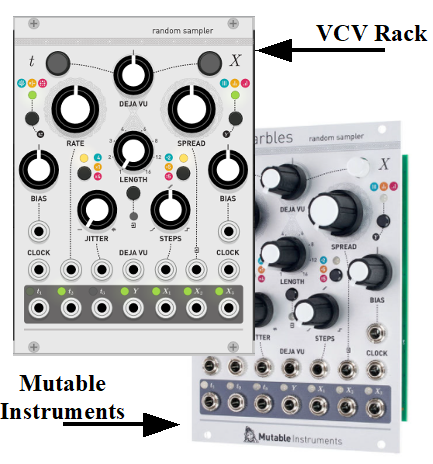
The module exists both as the original hardware design and as the VCV Rack module Random Sampler.
The Structure of Marbles
Marbles consists of three major sections:
The Time Domain
The CV Domain
- The Deja Vu Memory System
This article focuses on the Time Domain, which generates gates, triggers and rhythmic structures.
The Basic Gate Generator
At the heart of the Time Domain is a master gate sequence.
This sequence appears at output t2.
Marbles then distributes these gates between outputs t1 and t3 using probability decisions.
You can think of this as a sophisticated Bernoulli process:
t2 produces the master rhythm
t1 receives some of the gates
- t3 receives the remaining gates
The result is three related but distinct rhythmic streams.
Controlling Tempo with RATE
The RATE control determines the speed of the master sequence.
Three timing ranges are available:
Green = one quarter of the normal speed
Orange = normal speed
- Red = four times the normal speed
Marbles can operate from:
Its internal clock
- An external clock source
This makes it suitable both as a master rhythm generator and as part of a larger synchronized system.
Using BIAS for Probability Control
The BIAS parameter controls how often gates are sent to t1 versus t3.
With BIAS centered:
- Both outputs receive roughly equal numbers of gates
Turning BIAS left:
- t1 receives more gates
Turning BIAS right:
- t3 receives more gates
This allows gradual movement between different rhythmic balances without changing the underlying pulse.
Adding Controlled Irregularity with JITTER
The JITTER parameter introduces timing variations.
Instead of every gate arriving exactly on the beat, Marbles can move trigger positions slightly earlier or later.
Small amounts of JITTER create a humanized feel.
Higher amounts can produce highly unpredictable rhythmic structures.
Because the underlying pulse remains intact, the results often feel musical rather than chaotic.
The Three Time-Domain Modes
Marbles offers three timing algorithms.
Green Mode: Probabilistic Distribution
This is the default mode.
The master sequence at t2 is distributed probabilistically between t1 and t3.
This mode behaves similarly to a Bernoulli gate.
Orange Mode: Multiplication and Division
In this mode Marbles randomly multiplies or divides the master rhythm.
With BIAS centered:
- Both wing outputs receive similar rhythmic variations
Moving BIAS shifts the multiplication toward one side and division toward the other.
The result is rhythmic complexity derived from a common pulse source.
Red Mode: Alternating Outputs
In Red mode the wing outputs alternate activity.
BIAS determines how many triggers one side receives before activity shifts to the other side.
This produces call-and-response style rhythmic structures.
Practical Generative Applications
The Time Domain is particularly useful for:
Generative drum programming
Probabilistic percussion
Evolving trigger patterns
Multi-voice rhythmic structures
Ambient rhythm generation
- Polyrhythmic patch design
Because all outputs share a common timing relationship, even highly random results remain surprisingly coherent.
Conclusion
The Time Domain transforms a simple clock into an evolving network of related rhythms. By combining RATE, BIAS and JITTER with the three operating modes, Marbles can create anything from subtle timing variations to highly complex generative percussion systems.
Just click here to get more details about this topic, including graphs, presets, patches and videos.
Related articles
- Mutable Instruments Marbles CV Domain Explained: Random Voltages, Quantization and Probability
- Mutable Instruments Marbles Deja Vu Explained: Looping, Memory and Controlled Randomness
- Using Bernoulli Gate Networks in Generative Music
- Random Harmonic Progressions in Generative Music Using Sequential Switches