
Major and Minor Scales Explained: Patterns, Pentatonics and Mood
How do major, minor and pentatonic scales work, and how can electronic musicians use them to create different musical moods?
What is a musical scale?
A musical scale is an organised sequence of notes. Scales provide a framework for melodies, chords and musical themes.
For electronic musicians, understanding scales can be useful even if you primarily work with sequencers, generative patches, arpeggiators or random-voltage sources. A scale gives you a way to organise pitches and influence the character of the musical material your system produces.
Different scales have different interval patterns. These patterns contribute to the characteristic sound of each scale.
The major scale: a pattern of whole tones and semitones
The C major scale is an ideal starting point because it uses only the white keys of a conventional keyboard:
C – D – E – F – G – A – B – C
The intervals between consecutive notes follow this pattern:
Whole tone – Whole tone – Semitone – Whole tone – Whole tone – Whole tone – Semitone
In abbreviated form:
2 – 2 – 1 – 2 – 2 – 2 – 1 semitones
This is the defining interval pattern of the major scale.
If you start on G rather than C and preserve the same pattern, you obtain G major:
G – A – B – C – D – E – F-sharp – G
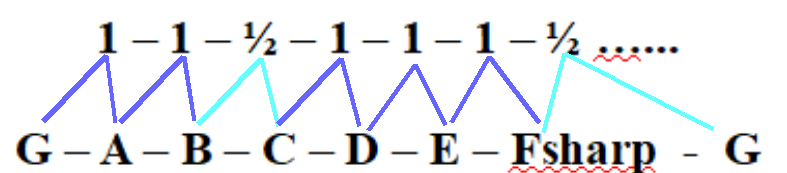
The F-sharp is necessary to preserve the major-scale pattern.
The same principle works for all twelve possible starting notes in the conventional twelve-tone system. You do not need to memorise every scale separately if you understand how the pattern works.
Minor scales: three different forms
Minor scales are somewhat more complex because there are three commonly distinguished forms:
- Natural minor
- Harmonic minor
- Melodic minor
Each has its own interval pattern. The melodic minor scale also has a traditional distinction between its ascending and descending forms.
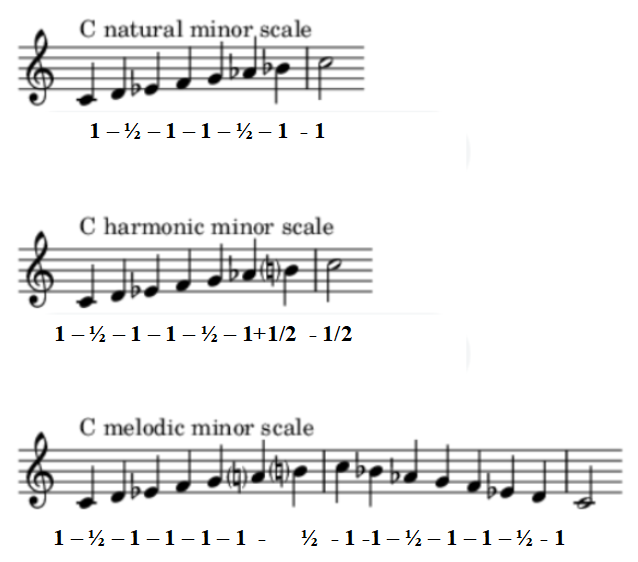
These differences matter because changing even one note can alter the character of a melody or chord progression.
For example, the natural A minor scale uses the same notes as C major:
A – B – C – D – E – F – G – A
This relationship is called the relative major/minor relationship. C major and A minor share the same collection of notes, but they have different tonal centres.
The relative minor of a major scale begins three semitones below the major scale's root note. Conversely, the relative major begins three semitones above the minor root.
This is a useful relationship to explore when composing because you can change the tonal centre while retaining the same basic collection of pitches.
Scales and musical mood
Scales are often associated with particular emotional qualities. Major scales are commonly described as bright or stable, while minor scales are often described as darker or more introspective.
These associations are useful starting points, but they are not absolute rules. Rhythm, tempo, instrumentation, register, dynamics and harmony also contribute to a piece's emotional character.
A practical experiment is to play the same short melody in two different scales. Change the notes as required by each scale, but keep the rhythm and overall melodic contour similar.
Listen to what changes.
This is particularly effective with synthesizers, where you can keep the same sound design and sequencing while changing the pitches. You can then hear how the musical material itself influences the result.
The pentatonic scale: five notes with a distinctive character
Not every scale needs to contain seven notes.
A pentatonic scale contains five notes per octave. One example is the C minor pentatonic scale:
C – E-flat – F – G – B-flat
The intervals between its consecutive notes are:
3 – 2 – 2 – 3 – 2 semitones
This scale is useful for exploring melodic ideas with a different character from the major scale.
Try using it with a slow sequencer, a generative patch, or a randomly changing control-voltage source. Restricting the available pitches can make random melodies feel more coherent without removing their capacity to evolve.
Pentatonic scales are also useful when you want to create melodic material without relying on every note of a seven-note scale.
Relative major and minor in practice
Let's return to C major and A minor:
C major: C – D – E – F – G – A – B
A natural minor: A – B – C – D – E – F – G
Both scales use the same notes, but they organise them around different tonal centres.
You can explore this relationship by playing the following chords repeatedly:
- C–E–G
- A–C–E
Then expand the sequence:
- C–E–G
- A–C–E
- G–B–D
- G–C–E
These examples introduce the relationship between scales and chords. Even without extensive music-theory knowledge, you can listen to how the sequence changes when you move between different groups of notes.
In a generative patch, you could use a quantizer to restrict randomly generated voltages to a chosen scale, then use separate voices to create melodic or harmonic material. The scale helps constrain the available pitches, while the generative system determines when and how they occur.
A practical exercise for your synthesizer
Try the following experiment:
- Choose a simple sound and a short melodic sequence.
- Create a melody using the notes of C major.
- Change the tonal centre to A minor while retaining the same collection of notes.
- Listen for changes in the sense of musical arrival and movement.
- Try C minor pentatonic and compare the result.
- If your modular system includes a quantizer, configure it for each scale and experiment with random CV.
Do not judge the results only by whether they sound conventionally happy, sad or resolved. Listen for differences in tension, continuity, openness and melodic direction.
The goal is to develop an intuitive understanding of how a scale influences the musical possibilities available to you.
Continue learning
Scales provide the raw material for melodies and chords. The next step is to understand how several notes can be combined into chords and how chords can form progressions.
Continue with Chords and Basic Chord Progressions for Electronic Musicians when that article becomes available.