
Musical Intervals Explained: Semitones, Whole Tones and Tritones
What are musical intervals, how are they measured, and why do they matter when composing melodies?
What is a musical interval?
A musical interval is the distance between two pitches. It is one of the basic building blocks of melody and harmony.
You can explore intervals easily on a piano or synthesizer keyboard. Start with one note and play another note above or below it. The distance between the two pitches is the interval.
The smallest distance between two neighbouring keys on a conventional keyboard is called a semitone, also known as a half step or half tone.
A whole tone consists of two semitones.
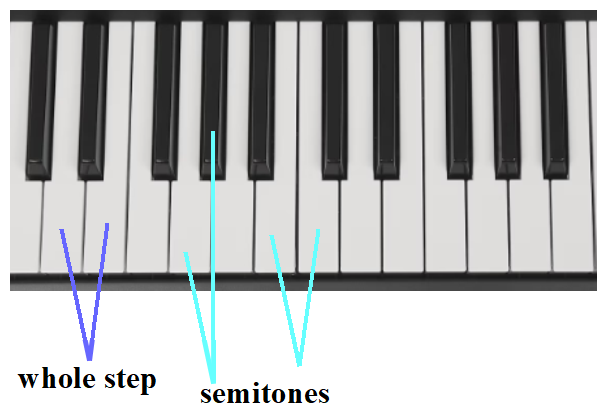
For example, moving from C to C-sharp is one semitone. Moving from C to D is two semitones, or one whole tone.
Semitones and whole tones on the keyboard
If you move from one key to the next, including both white and black keys, you move by one semitone.
When moving between white keys only, most steps are whole tones. There are two important exceptions:
- E to F is one semitone.
- B to C is one semitone.
This is why a keyboard's white keys do not form a sequence of equally spaced whole tones.
The C major scale uses the white keys:
C – D – E – F – G – A – B – C
Its pattern of whole tones and semitones is:
Whole – Whole – Half – Whole – Whole – Whole – Half
This pattern is important because it defines the major scale. Starting from another note and preserving the same pattern produces a major scale in another key.
Common intervals in the C major scale
The following table shows the intervals from C to the notes of the C major scale.
| Notes | Interval name | Semitones | Symbol |
|---|---|---|---|
| C–C | Perfect unison | 0 | P1 |
| C–D | Major second | 2 | M2 |
| C–E | Major third | 4 | M3 |
| C–F | Perfect fourth | 5 | P4 |
| C–G | Perfect fifth | 7 | P5 |
| C–A | Major sixth | 9 | M6 |
| C–B | Major seventh | 11 | M7 |
| C–C (next octave) | Perfect octave | 12 | P8 |
These names describe both the number of scale steps between the notes and the quality of the interval.
For example, a major third spans four semitones, while a perfect fifth spans seven semitones.
Sharps, flats and interval names
Intervals are not defined only by the number of semitones. Their written note names also matter.
A sharp raises a note by one semitone, while a flat lowers a note by one semitone.
This means that two intervals can cover the same number of semitones but have different theoretical names.
For example:
- C to C-sharp is an augmented unison.
- C to D-flat is a diminished second.
Both span one semitone, but they are written and understood differently in music theory.
Similarly, C to G-sharp is an augmented fifth, while C to A-flat is a diminished sixth. Both span eight semitones.
For practical electronic music composition, you can begin by learning how intervals sound and how many semitones they contain. More advanced interval spelling becomes useful when reading scores, analysing harmony, or communicating precise musical ideas.
The tritone: an interval of tension
One interval deserves special attention: the tritone.
A tritone spans six semitones, or three whole tones. It divides the octave into two equal parts.
Compared with more familiar intervals such as the perfect fifth, the tritone often creates a sense of instability or ambiguity. It can make a melody feel as if it is asking for a continuation rather than arriving at a resting point.
This quality can be extremely useful in electronic music. A tritone can introduce tension into a melodic phrase, create an unsettled atmosphere, or lead into an unexpected note.
The same musical tension that can make an interval seem unresolved can also make it expressive.
Learn intervals by listening
The most effective way to learn intervals is to combine theory with repeated listening.
Try this exercise:
- Choose a starting note on your synthesizer.
- Play a second note a semitone above it.
- Repeat with a whole tone, major third, perfect fourth and perfect fifth.
- Listen to the character of each interval.
- Repeat the exercise with different starting notes.
Do not concentrate only on memorising the names. Try to remember the sound and emotional character of each interval.
Over time, this practice helps you make more deliberate melodic choices without needing to calculate every note.
Continue learning
Intervals are the distances between pitches; scales are organised collections of pitches. Understanding both makes it easier to compose melodies and build chords.
Continue with Major and Minor Scales Explained for Electronic Musicians, which introduces scale patterns, relative minor, pentatonic scales and the relationship between scales and musical mood.