Randomness vs Stochastic Processes in Generative Music
What Is the Difference Between Random and Stochastic Music Generation?
Randomness vs Stochastic Processes in Generative Music
The words random and stochastic are often used interchangeably in electronic music discussions. While probability theory generally treats them as closely related concepts, it can be useful for composers to distinguish between them because they describe different musical behaviours.
Understanding this distinction helps us design generative systems more deliberately.
Completely Random Processes
A completely random process is one in which every technically possible outcome has the same probability of occurring.
Imagine a system generating pitches.
If every pitch can be followed by any other pitch—including the same pitch again—and all possibilities are equally likely, then the process is completely random.
The important point is that randomness does not necessarily imply change.
A random process may produce:
ten different notes in succession,
the same note ten times,
- or any combination in between.
Nothing can be excluded.
Limited Randomness
In music, completely unrestricted randomness is often less useful than some form of limitation.
For example:
restricting pitches to a scale,
limiting modulation ranges,
- constraining rhythm choices.
When certain outcomes are no longer possible, the process becomes limited random rather than completely random.
Many generative systems use this approach because it balances surprise with coherence.
What Is a Stochastic Process?
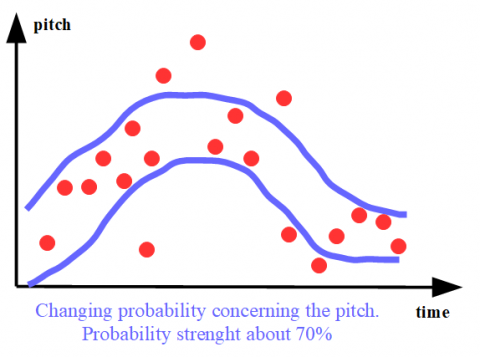
A stochastic process introduces unequal probabilities.
Certain events become more likely than others.
For example:
one note may occur twice as often as another,
lower pitches may be favoured over higher pitches,
- certain rhythms may have a greater chance of appearing.
The sequence remains unpredictable, but the probabilities are no longer evenly distributed.
Why This Matters Musically
Most listeners perceive probability distributions rather than individual events.
A melody in which some notes occur more frequently often sounds more intentional than a completely random sequence.
This is why stochastic methods are so important in generative composition.
They create structure without requiring explicit programming.
Conclusion
Completely random processes maximize unpredictability.
Limited random processes constrain possibilities.
Stochastic processes shape probabilities.
Understanding these three concepts provides the foundation for every advanced technique discussed later in this section of the knowledge base.
Just click here to get more details about this topic, including graphs, presets, patches and videos.