Sample & Hold Fundamentals for Generative Music
How Does Sample & Hold Generate Random Voltages?
Sample & Hold Fundamentals for Generative Music
Sample & Hold is one of the classic techniques used to generate random voltages in modular synthesis.
Although the basic patch is simple, its musical potential extends far beyond the familiar textbook example.
The Classic Patch
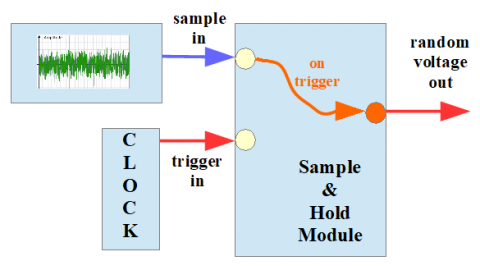
A traditional Sample & Hold patch consists of:
a noise source,
a Sample & Hold module,
- a trigger or clock source.
Whenever a trigger arrives, the module measures the current voltage at its input and holds that value until the next trigger arrives.
When white noise is used as the source, the resulting voltages are effectively completely random.
Why It Is Useful
The generated voltages can be routed to almost any destination:
oscillator pitch,
filter cutoff,
effect parameters,
LFO frequencies,
- sequencer controls.
Sample & Hold therefore becomes a universal source of generative variation.
Beyond White Noise
The real power of Sample & Hold appears when we stop thinking of it as merely a noise sampler.
Any changing signal can become a source.
This includes:
filtered noise,
LFO networks,
recorded control voltages,
field recordings,
- audio material.
Each source creates a different statistical character.
Why It Matters
Sample & Hold occupies a unique position in modular synthesis.
It can act as:
a source of randomness,
an analyser of signals,
a pattern extractor,
- a generator of probability-based behaviour.
This flexibility explains why it remains one of the most important modules in generative patch design.
Conclusion
Sample & Hold is not simply a random voltage generator. It is a method for converting continuously changing signals into discrete events, making it one of the fundamental tools of generative modular synthesis.
Just click here to get more details about this topic, including graphs, presets, patches and videos.