Sampling Complex Modulation Networks with Sample & Hold
Can Sample & Hold Capture Complex LFO Networks?
Sampling Complex Modulation Networks with Sample & Hold
White noise is not the only signal that can be sampled.
In fact, one of the most interesting applications of Sample & Hold involves sampling complex modulation networks.
Instead of sampling pure randomness, we sample structured behaviour.
Beyond Noise Sources
Any changing voltage can become a Sample & Hold source.
This includes:
single LFOs,
looping envelopes,
sequencers,
additive LFO networks,
serial modulation structures,
- feedback systems.
The resulting voltages inherit characteristics of the source network.
Structured Randomness
When a complex network is sampled, the resulting voltages are no longer completely random.
Depending on the architecture of the network, the output may exhibit:
limited randomness,
stochastic tendencies,
recurring structures,
- long-term probability shifts.
The Sample & Hold module effectively converts continuous complexity into discrete events.
Two Functions at Once
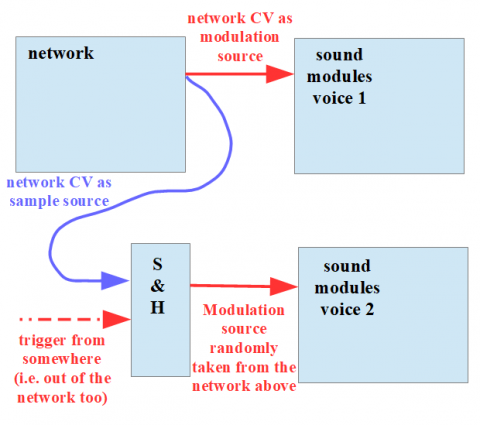
A particularly interesting observation from the book is that a modulation network can perform two functions simultaneously.
The network can:
act as a modulation source in the patch,
- serve as the signal being sampled.
This creates a rich web of interactions between different parts of the system.
Why This Matters
Many generative patches rely on randomness.
Sampling modulation networks provides an alternative.
Instead of generating random voltages directly, we generate voltages whose statistical behaviour emerges from the structure of the network itself.
Conclusion
Sampling complex modulation networks bridges the gap between deterministic systems and random systems. The resulting voltages often feel more coherent than pure noise while still remaining unpredictable.
Just click here to get more details about this topic, including graphs, presets, patches and videos.