Additive LFO Networks Explained
What Happens When You Mix Multiple LFOs Together?
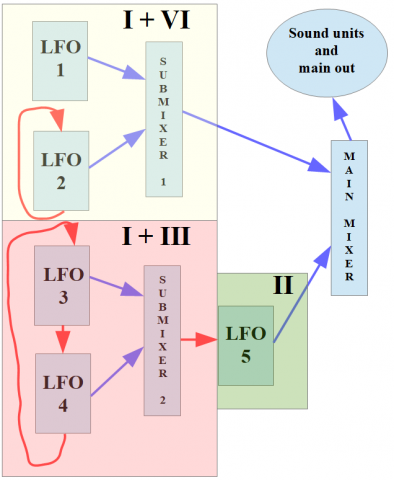
One of the simplest and most useful techniques in generative modular synthesis is the additive LFO network.
The concept is straightforward:
Instead of using a single LFO, multiple LFOs are combined by adding their voltages together.
The resulting control signal becomes far more complex than any individual modulation source.
The Basic Idea
Imagine two sine-wave LFOs.
Each produces a smooth cyclic voltage.
By mixing both signals together, a new waveform emerges.
This new waveform contains characteristics of both original cycles.
Because the two LFOs usually run at different frequencies, the shape constantly evolves.
The source material introduces this concept as one of the fundamental network structures used in generative music.
Why It Works
Each LFO contributes its own movement.
When combined, the resulting control voltage becomes richer and less predictable.
The listener does not hear the individual modulators.
Instead, the listener hears the musical consequences:
- evolving filter movements,
- changing timbres,
- shifting pitches,
- dynamic effects processing.
Creating Rich Modulation Signals
An additive network can control virtually any parameter.
Popular destinations include:
- oscillator pitch,
- filter cutoff,
- resonance,
- delay feedback,
- reverb parameters,
- granular controls.
The more independent cycles involved, the more complex the resulting behaviour becomes.
Choosing Waveforms
Different waveforms produce different musical results.
Sine waves often create smooth organic motion.
Triangle waves introduce more linear behaviour.
Square waves generate abrupt transitions.
Combining different waveform types often produces particularly interesting results.
Frequency Selection
The choice of frequencies is often more important than the choice of waveforms.
Closely related frequencies produce slow beating patterns.
Widely separated frequencies create more active behaviour.
Very slow modulators can shape the overall evolution of a patch.
Fast modulators can create local detail.
A mixture of both usually produces the most satisfying results.
A Foundation for Generative Melodies
Additive networks become especially powerful when routed through quantizers.
Instead of creating modulation signals, they begin generating melodies.
Many generative melodic systems are based on exactly this principle.
The additive network creates the raw voltage.
The quantizer transforms that voltage into notes.
Simplicity and Power
One reason additive networks are so popular is their simplicity.
No random generators are required.
No complex logic is required.
A handful of LFOs and a mixer can already produce remarkably rich musical behaviour.
Click here to get more information about the topic, including presets, patches, graphics and vidoes.