Using LFOs for Generative Music: Creating Long Musical Cycles Without Randomness
How Can LFOs Create Generative Music Without Using Random Sources?
Using LFOs for Generative Music: Creating Long Musical Cycles Without Randomness
Many musicians associate generative music primarily with random voltage sources, Sample & Hold modules, probability gates, or stochastic sequencers. These modules certainly play an important role in modular generative systems, but they are not the only way to create music that appears to evolve continuously.
One of the most powerful and often underestimated tools for generative music is the humble LFO.
The Problem with Simple Cycles
At first glance, an LFO seems unsuitable for generative music. After all, an LFO generates a repeating waveform. Once a cycle has finished, the next cycle starts exactly the same way. Nothing new happens.
This appears to contradict one of the central characteristics of generative music: continuous change.
However, this view only considers isolated LFOs operating on their own.
Long Cycles Create the Illusion of Permanence
Even a single slow LFO can produce surprisingly long developments.
When a modulation cycle lasts several minutes, listeners often perceive the result as continuously changing rather than repeating. The cycle technically repeats, but the repetition occurs so slowly that it becomes difficult to recognize.
The effect becomes much stronger when multiple LFOs operate together.
Introducing the Super-Cycle
Imagine two LFOs running at different frequencies.
One LFO completes a cycle every 25 seconds.
The other completes a cycle every 33 seconds.
Although each LFO repeats independently, both LFOs return to their original relationship only after 825 seconds.
This larger cycle can be regarded as a super-cycle: a long musical process built from several shorter cycles.
The listener no longer hears two repeating events. Instead, the listener experiences a constantly changing relationship between them.
Complexity Through Combination
The real power of LFOs emerges when several modulation sources interact.
Different LFOs can simultaneously control:
- Oscillator pitch
- Filter cutoff
- Effects parameters
- Envelope times
- Modulation depth
- Sequencer speed
Each modulation source follows its own cycle length. The interaction between these independent cycles produces highly complex musical behaviour.
The result often sounds random even though no random generator is involved.
Why Predictability Can Be Useful
Random sources are valuable, but complete randomness can make a patch difficult to control.
LFO-based systems offer another approach.
Because the behaviour is ultimately cyclical, the composer can:
- predict the general character of the music,
- shape the overall development,
- repeat successful patches,
- adjust relationships between modulation sources.
This creates a useful balance between control and surprise.
Beyond a Single LFO
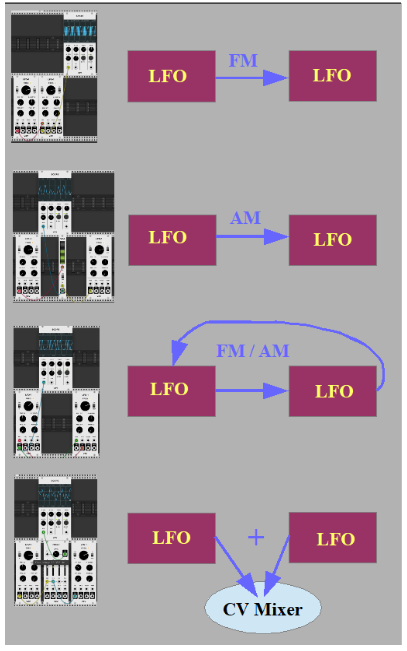
Generative systems become far more interesting when LFOs begin to influence one another.
Examples include:
- additive LFO networks,
- serial LFO networks,
- feedback structures,
- modulation of modulation depth,
- wave-shape modulation,
- phase modulation.
These techniques transform simple repeating cycles into evolving structures that can remain interesting for many minutes or even hours.
A Different View of Generative Music
Generative music is not defined by randomness alone.
A patch can be entirely deterministic and still create the impression of endless change. The secret lies in the interaction of multiple processes operating at different speeds.
LFOs are therefore not merely utility modules. They can serve as the fundamental engines that drive a complete generative composition.
Understanding how to combine and organize these cycles is one of the most important skills in modular generative music.
Where to Go Next
If you understand the concept of super-cycles, the next logical step is learning how LFOs can be combined into larger modulation structures.
Start by exploring:
- Additive LFO Networks
- Serial LFO Networks
- Feedback Loops with LFOs
- Modulating the Modulation
- Creating Generative Melodies from Cyclic Sources
These techniques reveal how simple repeating cycles can become sophisticated systems capable of producing rich generative music.
click here to go deeper into making generative Music.