LFO Feedback Loops in Modular Synthesis
How Do Feedback Loops Create Complex Generative Behaviour?
LFO Feedback Loops in Modular Synthesis
Feedback is one of the most powerful concepts in both music and nature.
Whenever a system influences itself, feedback emerges.
In modular synthesis, feedback can transform simple modulation sources into rich generative structures.
What Is Feedback?
A feedback loop occurs when a signal eventually returns to influence its own source.
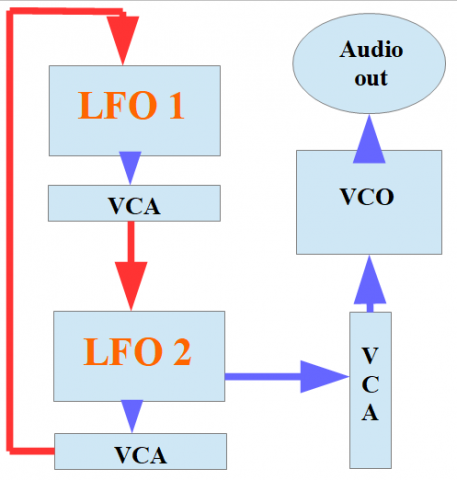
In an LFO network, this might mean:
an LFO influences its own frequency,
an LFO influences its own amplitude,
- multiple LFOs influence one another in a circular relationship.
The source material explores several forms of feedback structures that generate increasingly complex behaviour from simple cyclic components.
Why Feedback Matters
Without feedback, a system follows a fixed path.
With feedback, the path itself changes.
This introduces a level of complexity that often feels organic and unpredictable.
Positive and Negative Feedback
Positive feedback reinforces behaviour.
Negative feedback counteracts behaviour.
Both can be musically useful.
Positive feedback often produces dramatic movement.
Negative feedback can create self-balancing systems.
Musical Applications
Feedback loops can generate:
evolving modulation signals,
changing melodies,
dynamic timbres,
- long-term structural development.
In many generative patches, feedback becomes the primary source of novelty.
Proceed Carefully
Feedback is powerful but can become unstable.
Small changes may have large consequences.
This is not necessarily a problem.
In generative music, controlled instability is often highly desirable.
Just click here to get more details about the topic, including graphs, patches and videos.