Modulating the Modulation: Controlling Modulation Depth with LFOs
What Does "Modulating the Modulation" Mean in Modular Synthesis?
Modulating the Modulation: Controlling Modulation Depth with LFOs
Most modular musicians eventually learn how to use an LFO to modulate a parameter.
For example:
an LFO modulates filter cutoff,
an LFO modulates oscillator pitch,
- an LFO modulates effect parameters.
However, a powerful generative technique begins when the modulation itself becomes a target for further modulation.
This concept is often called meta-modulation or modulating the modulation.
A Simple Example
Imagine an LFO controlling a filter.
The filter moves continuously.
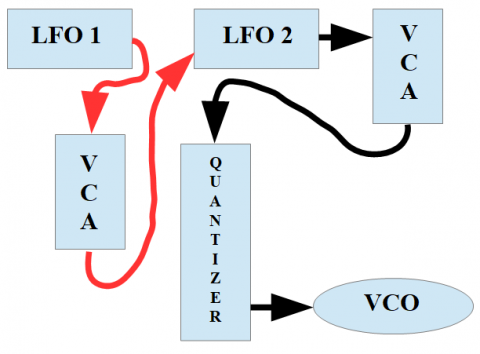
Now place a VCA between the LFO and the filter.
The VCA determines how much of the modulation reaches the filter.
Finally, use a second LFO to control the VCA.
The result is no longer a fixed modulation depth.
Instead, the amount of modulation changes over time.
The source material identifies this as one of the fundamental ways of creating richer generative behaviour from otherwise simple modulation networks.
Why This Matters
Without meta-modulation:
The movement remains constant.
With meta-modulation:
The intensity of movement evolves.
Sometimes the modulation is subtle.
Sometimes it becomes dramatic.
The listener perceives a living process rather than a repeating cycle.
Musical Applications
Meta-modulation can influence:
filter movement,
vibrato depth,
FM intensity,
effect processing,
rhythmic activity,
- melodic range.
Almost any modulation path can become a target.
Creating Hierarchies of Change
One of the most important ideas in generative music is the existence of multiple time scales.
Fast processes create local detail.
Slow processes shape large-scale form.
Meta-modulation provides an elegant method for connecting these levels.
A slow LFO can gradually reshape the behaviour of faster modulation sources.
The Foundation of Advanced Generative Systems
Many sophisticated modular patches rely heavily on meta-modulation.
The technique allows simple components to generate surprisingly rich behaviour without introducing excessive complexity.
Click here to get more information about the topic, including graphs, patches and videos.