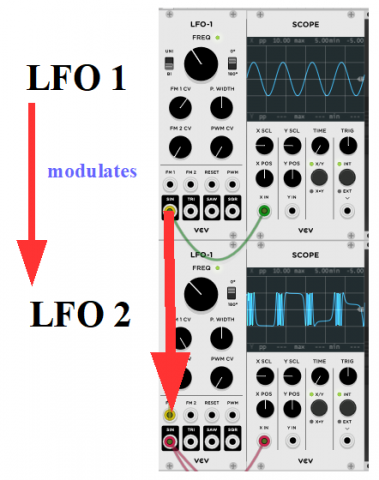
Serial LFO Networks Explained: Modulating One LFO with Another
What Happens When One LFO Modulates Another LFO?
Serial LFO Networks Explained: Modulating One LFO with Another
An additive LFO network combines multiple modulation sources side by side. A serial LFO network takes a different approach.
Instead of combining modulation sources, one LFO directly influences another.
This seemingly simple idea creates a dramatic increase in complexity and is one of the most powerful techniques in generative modular synthesis.
From Parallel to Serial Thinking
Imagine two LFOs.
In an additive network, both control the same destination.
In a serial network, one LFO controls a parameter of the other.
For example:
LFO A controls filter cutoff.
- LFO B controls the frequency of LFO A.
Now the modulation itself is changing continuously.
The result becomes far less predictable.
Why Serial Networks Feel More Organic
A normal LFO repeats.
A serial network continuously changes the conditions under which repetition occurs.
The listener no longer hears a simple cycle.
Instead, the listener hears a process that constantly reshapes itself.
The source material introduces serial LFO structures as a fundamental generative technique in which one cyclic process influences another. This creates increasingly complex long-term behaviour from relatively simple components.
Common Applications
Serial networks are useful for:
evolving filter movements,
changing rhythmic densities,
generative melodies,
shifting effect parameters,
- long-form ambient structures.
The technique works particularly well when very slow modulators influence somewhat faster modulators.
Degrees of Complexity
Not all serial networks are equally complex.
Simple examples may involve only two LFOs.
More advanced systems may contain entire chains:
LFO A → LFO B → LFO C → Destination
Each additional layer increases the number of interactions.
Control Versus Surprise
One advantage of serial networks is that they remain deterministic.
The patch still follows rules.
Yet the resulting behaviour often feels unpredictable.
This balance between order and surprise makes serial modulation a cornerstone of generative patch design.
For more and deeper insights, graphics, patches and screenshots just click here.