Understanding Frequency Relationships in LFO Networks
Why Do LFO Frequency Ratios Matter in Generative Music?
Understanding Frequency Relationships in LFO Networks
Many modular musicians focus on waveform selection.
Sine wave or triangle?
Square wave or sawtooth?
While waveforms certainly matter, the relationships between frequencies often have a much greater impact on a generative patch.
Every Frequency Creates a Time Scale
An LFO running every two seconds creates a different musical experience than an LFO running every three minutes.
Frequency determines how quickly change occurs.
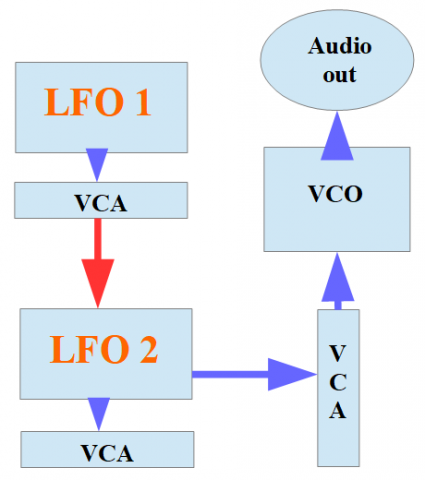
When several LFOs interact, their frequency relationships define the overall behaviour of the patch.
Related Versus Unrelated Frequencies
Simple ratios create relatively predictable interactions.
Examples include:
1:2
1:4
- 2:3
More unusual relationships often produce longer developments.
The source material demonstrates how differing cycle lengths can dramatically extend the duration before a complete pattern repeats.
Musical Consequences
Frequency relationships influence:
melodic development,
rhythmic behaviour,
timbral movement,
- large-scale structure.
Changing a single frequency may completely alter the character of a patch.
The Role of Super-Cycles
Every set of interacting frequencies generates a larger composite cycle.
This super-cycle determines how long the patch takes to return to a previously heard state.
Long super-cycles are often desirable in ambient and generative music because they create the impression of continuous development.
Practical Advice
When building generative systems:
Avoid making every LFO a simple subdivision of another.
Experiment with unusual ratios.
Combine fast, medium, and slow cycles.
- Listen for long-term behaviour rather than short-term effects.
These principles often produce more interesting results than simply adding additional modules.
Learn more about this topic with more explanations, grphics, patches and videos by clicking here.