What is a Super-Cycle in Modular Synthesis?
Why Do Multiple LFOs Create Extremely Long Repeating Patterns?
What Is a Super-Cycle in Modular Synthesis?
One of the most important concepts in generative modular synthesis is the idea of the super-cycle.
Understanding this concept helps explain why a patch can sound endlessly evolving even when it contains no random sources whatsoever.
Starting with Two Simple Cycles
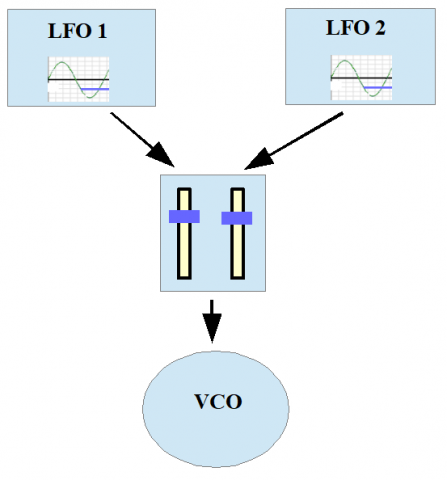
Imagine two LFOs.
The first completes a cycle every 25 seconds.
The second completes a cycle every 33 seconds.
Individually, both LFOs repeat quite frequently.
Neither appears particularly interesting on its own.
However, the relationship between them tells a different story.
When both LFOs start together, their peaks and valleys gradually drift apart because their cycle lengths differ.
At some moments they reinforce one another.
At other moments they oppose one another.
The relationship constantly changes.
When Do They Meet Again?
Eventually, both LFOs return to their original alignment.
The source material (see booklink below) demonstrates this with an example where one LFO requires 25 cycles and the other requires 33 cycles before both return to their original relationship. This produces an overall cycle lasting 825 seconds.
That larger cycle is what we call a super-cycle.
The individual cycles are the components.
The super-cycle is the behaviour of the complete system.
Why Super-Cycles Matter
Listeners rarely focus on individual modulation sources.
Instead, they perceive the overall behaviour of the patch.
A patch containing several interacting cycles can continue changing for many minutes before reaching a previously heard state.
This creates the impression of continuous evolution.
Technically the system remains deterministic.
Musically it feels alive.
Creating Longer Super-Cycles
The easiest way to extend a super-cycle is to add more modulation sources.
Suppose a third LFO is introduced.
Now three independent cycle lengths interact simultaneously.
The resulting overall cycle becomes dramatically longer.
The source material demonstrates examples where additional LFOs increase the apparent complexity and dramatically extend the overall development time.
Even relatively simple modulation sources can therefore generate musical developments lasting many minutes.
The Art of Choosing Frequencies
Not all frequency relationships are equally useful.
Closely related frequencies often produce slowly evolving interactions.
Widely separated frequencies may create more dramatic changes.
The composer can therefore influence the character of a patch simply by adjusting the relationships between cycle lengths.
In practice, much of generative composition involves selecting and refining these relationships.
Super-Cycles and Musical Form
Traditional composition often relies on consciously planned structure.
Generative composition can create structure automatically.
The super-cycle becomes a form of large-scale architecture.
Instead of writing every detail manually, the composer designs interacting systems that generate evolving forms over time.
This approach is particularly useful in:
- ambient music,
- installation music,
- generative soundscapes,
- experimental electronic music,
- long-form modular performances.
A Foundation for More Advanced Techniques
Many advanced modular techniques ultimately build upon the concept of the super-cycle.
Additive networks create super-cycles.
Serial networks create super-cycles.
Feedback systems create super-cycles.
Complex modulation architectures create super-cycles.
Understanding this concept provides a foundation for nearly every advanced form of generative patch design.