Amplitude Modulation with LFO Networks
How Can Amplitude Modulation Create More Interesting Generative Patches?
Amplitude Modulation with LFO Networks
Amplitude modulation is often associated with audio-rate synthesis.
However, the same principle can be applied to control voltages and LFO networks.
In generative music, amplitude modulation becomes a powerful tool for creating evolving behaviour.
What Is Amplitude Modulation?
Amplitude modulation changes the strength of a signal.
When applied to an LFO, it changes the amount of influence that LFO has on its destination.
The modulation remains active.
Its intensity changes.
The source material discusses controlling modulation strength as a means of producing continuously evolving relationships within LFO networks.
Static Versus Dynamic Modulation
A fixed modulation depth produces predictable behaviour.
Dynamic modulation depth produces evolving behaviour.
This distinction may seem small, but musically it is profound.
The listener perceives motion within motion.
Practical Examples
Amplitude modulation can create:
gradually increasing filter movement,
changing vibrato intensity,
evolving rhythmic accents,
- shifting timbral activity.
The technique works especially well in ambient music, where subtle long-term developments are often more important than dramatic events.
Musical Benefits
Amplitude modulation helps avoid one of the most common problems in generative patches:
predictable behaviour.
Even if the underlying modulation source repeats, changing its amplitude creates additional layers of variation.
Combining Multiple Levels
Amplitude modulation becomes especially powerful when combined with:
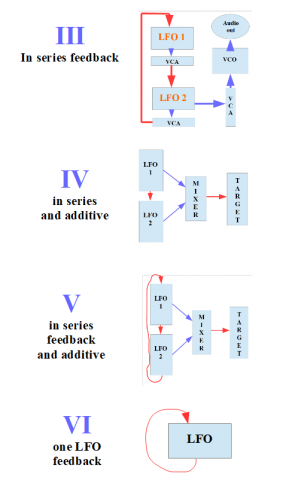
serial networks,
feedback structures,
phase relationships,
- wave-shape modulation.
Each added layer increases the richness of the resulting system.
Get more info about this topic including graphics, presets, patches and videos by clicking here.