Shaping Randomness with Filters and VCAs in Modular Synthesis
How Can Filters and VCAs Control Random Voltages?
Shaping Randomness with Filters and VCAs in Modular Synthesis
Many musicians assume that random voltages generated by a Sample & Hold module must remain completely random.
In reality, the character of randomness can be shaped and sculpted long before the voltages reach their destination.
One of the most effective methods is to process the signal being sampled.
Starting with White Noise
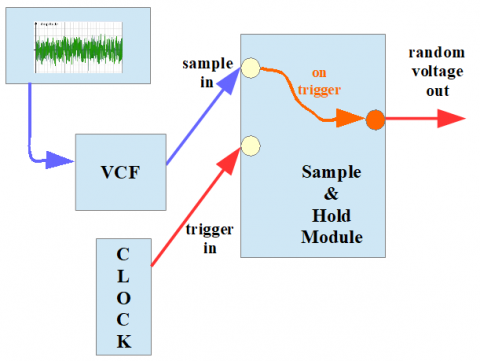
A classic Sample & Hold patch uses white noise as its source.
Because white noise contains a broad range of amplitudes, every voltage level has a chance of being sampled. This creates a process that approaches complete randomness.
However, the nature of that randomness changes when we begin processing the noise.
Using Filters
A low-pass filter reduces higher amplitudes in the signal.
As a result, high voltage values become less likely to be sampled.
Importantly, they do not disappear completely. Their probability simply declines.
This turns a completely random process into a stochastic one.
Certain voltage ranges become more probable than others.
Creating Probability Masks
The book introduces an especially powerful technique: modulating the filter cutoff frequency.
As the cutoff changes, the probability distribution changes with it.
At one moment higher voltages may be relatively common.
Later they may become rare.
This creates what can be understood as a probability mask.
The process remains random, but its tendencies evolve over time.
Using VCAs
VCAs work differently.
Instead of changing probabilities gradually, they can establish hard boundaries.
If high voltages are prevented from reaching the Sample & Hold input, those values become impossible to sample.
The result is limited randomness rather than stochastic behaviour.
Combining Both Approaches
Filters and VCAs complement one another.
Filters influence probability.
VCAs establish limits.
Used together, they allow the composer to control both the shape and the range of random processes.
Conclusion
Randomness is not an all-or-nothing phenomenon. By applying filters and VCAs before or after a Sample & Hold stage, a composer can transform raw randomness into musically meaningful behaviour while preserving the possibility of surprise.
Just click here to get more details about this topic, including graphs, presets, patches and videos.