Sample & Hold with Periodic Signals: From Randomness to Structure
What Happens When a Sample & Hold Samples a Saw Wave Instead of Noise?
Sample & Hold with Periodic Signals: From Randomness to Structure
Sample & Hold modules are usually associated with noise sources.
However, sampling periodic signals often leads to even more interesting musical results.
The focus shifts away from randomness and toward relationships.
Replacing Noise with a Saw Wave
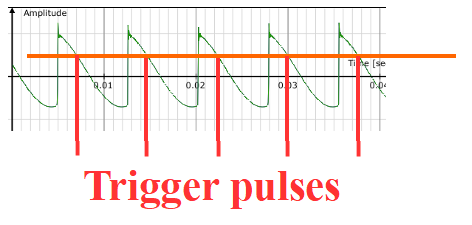
Imagine feeding a saw wave into a Sample & Hold module.
The module is triggered by a clock signal.
Now two frequencies determine the behaviour of the system:
the frequency of the saw wave,
- the frequency of the trigger.
The relationship between these frequencies becomes crucial.
When Both Frequencies Are Equal
If the trigger and the saw wave run at exactly the same frequency, the Sample & Hold module samples exactly the same point of the waveform every time.
No variation occurs.
The output becomes completely static.
Integer and Non-Integer Relationships
As the relationship changes, the output changes dramatically.
Certain frequency ratios create regular arpeggio-like patterns.
Others create sequences that appear partially ordered and partially irregular.
The resulting behaviour depends entirely on the interaction of the two cycles.
Walking In and Out of Regularity
A particularly elegant technique is to use a non-integer frequency relationship and slowly modulate the trigger frequency.
The resulting voltage sequence gradually moves between order and disorder.
The listener experiences a process that continually reshapes itself.
Connections to Earlier Concepts
This behaviour closely relates to concepts discussed elsewhere in generative music:
super-cycles,
frequency relationships,
cyclic modulation networks,
- emergent structure.
The same principles that govern interacting LFOs also govern Sample & Hold systems driven by periodic signals.
Conclusion
Sampling periodic signals reveals that Sample & Hold is not merely a random-voltage generator. It is a tool for exploring relationships between cycles. By choosing appropriate frequency ratios, composers can create musical structures ranging from strict order to controlled irregularity.
Just click here to get more details about this topic, including graphs, presets, patches and videos.