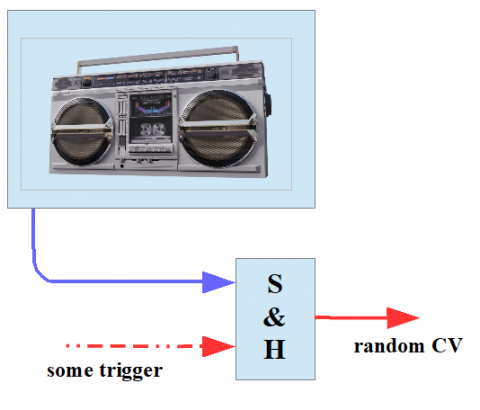
Using Recordings as Sources of Random Voltages
Can Audio Recordings Be Used to Generate Random Control Voltages?
Using Recordings as Sources of Random Voltages
Most discussions of Sample & Hold focus on white noise.
Yet recordings can be equally powerful sample sources.
In many situations they offer far greater control over the statistical behaviour of the resulting voltages.
What Can Be Recorded?
Almost anything.
Examples include:
field recordings,
recordings of your own music,
recorded control-voltage developments,
environmental sounds,
- complex modular patches.
Any recording containing changing amplitudes can become a source for Sample & Hold.
Designing Probability Distributions
One of the most interesting possibilities is intentionally creating recordings with specific amplitude distributions.
For example:
mostly low levels with occasional peaks,
mostly high levels with occasional drops,
gradually rising amplitudes,
- gradually falling amplitudes.
The recording itself becomes a probability design tool.
Random, Limited Random, or Stochastic
The resulting behaviour depends on the structure of the recording.
Carefully planned recordings can produce:
completely random sequences,
limited random sequences,
stochastic processes,
- evolving probability masks.
Analysing Existing Recordings
The book points out another intriguing possibility.
Instead of generating new material, Sample & Hold can be used to analyse existing recordings.
The playback functions of a sample player—looping, changing start and end points, ping-pong playback, and random jumps—can interact with the sampling process in unexpected ways.
Conclusion
Recordings transform Sample & Hold from a random-voltage generator into a tool for exploring and shaping statistical behaviour. By designing the recording, the composer indirectly designs the randomness.
Just click here to get more details about this topic, including graphs, presets, patches and videos.