Using Envelopes to Modulate LFOs in Modular Synthesis
How Can an Envelope Generator Modulate an LFO in a Modular Synthesizer?
Using Envelopes to Modulate LFOs in Modular Synthesis
One of the simplest ways to create more sophisticated control voltages is combining an envelope generator with a low-frequency oscillator. A particularly useful approach is letting the envelope modulate the behaviour of the LFO itself.
The Basic Principle
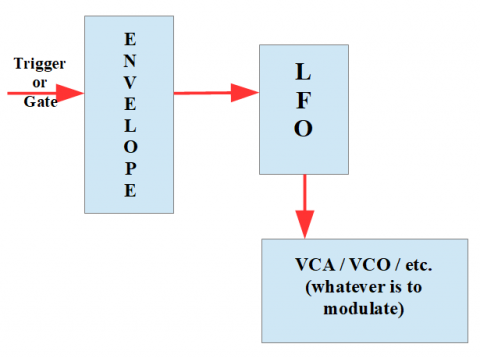
In this configuration the envelope becomes the controller and the LFO becomes the controlled device.
Instead of sending the envelope directly to a modulation target, the envelope modulates one or more LFO parameters, such as:
Frequency
Pulse width
Amplitude
- Shape parameters (if available)
The resulting LFO output is then used as the actual modulation signal.
Why This Works
An LFO normally repeats the same cycle indefinitely.
An envelope introduces a time-dependent evolution.
Combining the two allows the modulation itself to evolve.
For example:
The LFO may start slowly and become faster.
The pulse width may gradually widen.
- The modulation depth may grow and then fade.
The result is a modulation signal with a beginning, development and ending.
Musical Applications
Envelope-controlled LFOs are useful for:
Filter modulation
Pitch vibrato development
Dynamic effects processing
Slowly evolving ambient textures
- Generative melodic variation
Trigger Rate Matters
The character of the resulting modulation depends heavily on how often the envelope is triggered.
Changing the trigger frequency effectively changes the overall shape of the generated control voltage.
Conclusion
Allowing an envelope generator to modulate an LFO transforms a simple cyclic signal into a more expressive and evolving source of control voltage.
Just click here to get more details about this topic, including graphs, presets, patches and videos.