Voice Switching in Generative Modular Synthesis
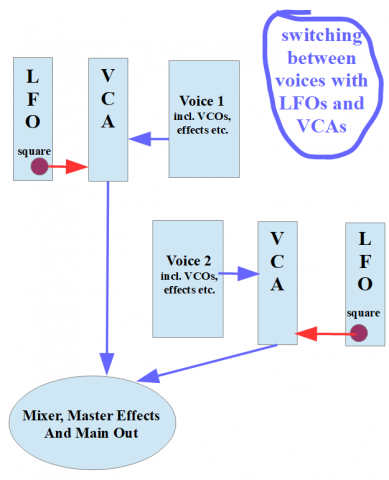
How Can Multiple Voices Be Switched On and Off Automatically in a Modular Patch?
Voice Switching in Generative Modular Synthesis
One of the most effective ways to change the character of a generative patch is not by changing notes, rhythms, or timbres, but by changing which voices are active.
A patch containing several independent voices can produce dramatically different musical results simply by activating and deactivating selected signal paths.
The Simplest Approach
The most direct method uses a VCA controlled by a modulation source such as:
an LFO,
a clock divider,
a probability source,
- a Gray Code module.
Whenever the control signal rises above a chosen threshold, the voice becomes audible.
When the control signal falls, the voice disappears.
Why Voice Switching Matters
A voice often contains an entire musical identity:
a specific timbre,
a melodic role,
a rhythmic behaviour,
- a processing chain.
Switching voices therefore changes far more than a single parameter.
Building Larger Structures
Voice activation can create:
sections,
transitions,
call-and-response behaviour,
- evolving arrangements.
A patch may continue generating material indefinitely while still presenting clear structural development.
Conclusion
Voice switching transforms a collection of individual modules into a larger musical ecosystem. Instead of continuously changing sounds, the patch changes which musical actors participate in the performance.
Just click here to get more details about this topic, including graphs, presets, patches and videos.