Why Generative Rhythm Needs a Master Clock
Should Generative Rhythms Use Clocks Instead of LFOs?
Why Generative Rhythm Needs a Master Clock
Many beginners use an LFO as the timing source for rhythm generation.
While this works for isolated patches, it often creates problems when several rhythmic systems must cooperate.
The Limitation of LFO-Based Timing
An LFO generates periodic events.
However, it is usually not designed to manage:
tempo,
meter,
synchronization,
- clock distribution.
As a result, integrating multiple rhythmic subsystems becomes difficult.
The Advantage of Dedicated Clocks
Clock modules provide:
BPM control,
synchronized outputs,
divisions,
multiplications,
- rhythmic consistency.
This makes them better suited as the rhythmic foundation of larger generative systems.
Randomness Still Needs Structure
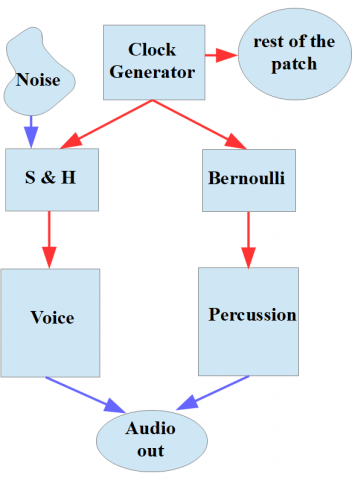
The chapter demonstrates that random pitches and random percussion events become more useful when both remain tied to a common clock.
The events may be unpredictable, but they still relate to a shared pulse.
Conclusion
Randomness becomes musically meaningful when it occurs within a stable rhythmic framework. Dedicated clocks provide that framework.
Just click here to get more details about this topic, including graphs, presets, patches and videos.