Combining Stable Chord Changes with Random Melodies in Generative Music
How do you create random melodies over stable chord progressions in modular synthesis?
Combining Stable Chord Changes with Random Melodies
A powerful compositional strategy is combining predictable harmonic movement with unpredictable melodic development.
Instead of making everything random, one part of the system remains stable while another part continuously changes.
The listener perceives both structure and surprise at the same time.
The Principle
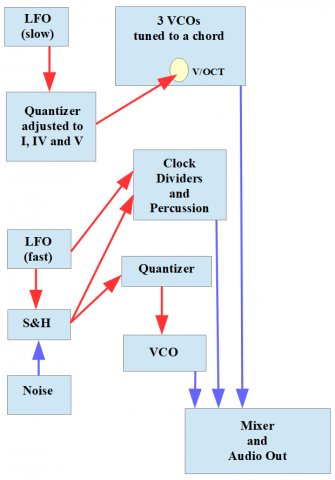
Imagine three oscillators forming a chord.
The chord changes slowly and regularly.
For example:
C minor
F minor
- G minor
These changes happen in a predictable manner.
At the same time a fourth oscillator generates notes independently through a random process such as Sample & Hold.
The random melody moves above the stable harmonic foundation.
Why Stability Matters
Random melodies become much easier to understand when they are heard within a stable harmonic context.
The chord progression creates expectations.
The random melody then reacts to those expectations.
Without the harmonic framework, the same melody might sound arbitrary.
With the framework, it sounds expressive.
Independent Time Scales
A particularly effective arrangement uses different speeds.
The chord progression changes slowly.
The random melody changes quickly.
This creates two simultaneous layers:
a large-scale harmonic movement
- a small-scale melodic movement
The interaction between both layers produces continuous variation.
Musical Benefits
The technique offers several advantages.
Coherence
The harmonic structure keeps the composition unified.
Variety
The melody never repeats exactly.
Long-Term Interest
Listeners can follow the harmony while still discovering new details.
Emotional Direction
The chord progression shapes the emotional character of the piece.
The random melody adds unpredictability without destroying that character.
Expanding the Concept
The same principle can be applied to:
bass lines
percussion voices
granular processors
effect parameters
- entire sub-patches
The essential idea remains unchanged:
one element provides structure while another provides variation.
A Core Principle of Generative Composition
Many successful generative pieces are neither completely deterministic nor completely random.
Instead they combine both.
Stable harmony plus evolving melody is one of the clearest examples of this principle and remains one of the most useful tools for creating generative music that remains engaging over long periods of time.
Just click here to get more details about this topic, including graphs, presets, patches and videos.