Creating Random Chords from a Single Arpeggio Source in Modular Synthesis
How can a single arpeggio generate multiple random harmonies in a modular synthesizer?
Creating Random Chords from a Single Arpeggio Source
One of the most fascinating ways to generate harmony is starting with a single melodic source and allowing several voices to derive different notes from it.
Instead of creating separate melodies, a common source generates an entire harmonic texture.
The Central Idea
Begin with an arpeggio.
The arpeggio serves as the master pitch source.
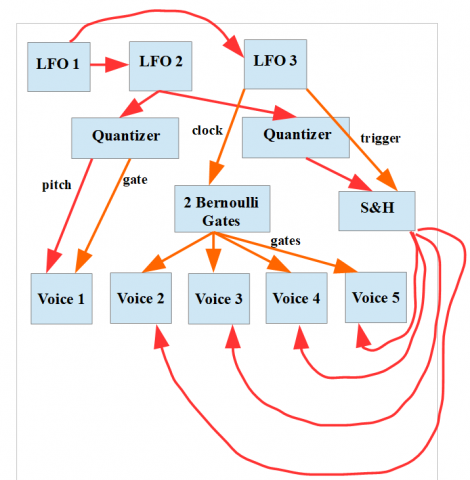
A Sample & Hold module continuously samples this pitch information.
Several oscillators then receive the resulting voltages.
Because every voice originates from the same source, all notes remain related.
The resulting harmony sounds coherent even though it changes randomly.
Introducing Independent Voices
Each oscillator is connected to its own VCA.
Bernoulli gates determine when these VCAs open.
As a result:
some voices appear
some disappear
- some overlap
Different combinations emerge continuously.
The listener perceives changing harmonic structures even though only one original pitch source exists.
Why It Sounds Musical
Random harmonies often become chaotic because the voices are unrelated.
In this system all voices inherit material from the same arpeggio.
This common ancestry creates a strong musical connection between the notes.
Even complex harmonic results retain a recognizable identity.
The Role of Bernoulli Gates
Bernoulli gates provide probabilistic voice activation.
Every voice has its own statistical behavior.
This means:
some notes occur frequently
- others occur only occasionally
The harmony develops naturally and avoids mechanical repetition.
Harmonic Density
The number of active voices changes constantly.
Sometimes only one or two notes are audible.
Sometimes several voices combine into rich chord structures.
This continuously changing density contributes greatly to the feeling of evolution.
Musical Applications
This technique works particularly well for:
ambient music
generative orchestral textures
evolving drones
cinematic underscoring
- experimental harmony
Because all harmony grows from a single source, the resulting sound remains unified while continuously transforming.
A Harmony Generator Rather Than a Chord Generator
Traditional composition often starts by selecting chords.
This technique reverses the process.
A single melodic source generates notes.
Probability determines which notes become audible.
Harmony emerges naturally from the interaction of pitch relationships and statistical voice activation.
The result is not a programmed chord progression but an evolving harmonic ecosystem.
Just click here to get more details about this topic, including graphs, presets, patches and videos.