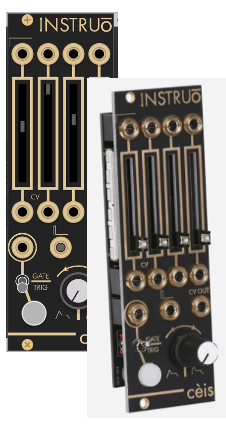
Instruō Cèis: An ADSR Envelope Generator Designed for Modular Control
What Makes the Instruō Cèis ADSR Envelope Generator Different?
What Is Instruō Cèis?
Instruō Cèis is an advanced ADSR envelope generator available both as a Eurorack hardware module and as a software module in VCV Rack.
At first glance, Cèis appears to be a traditional ADSR envelope generator. However, several additional features make it much more useful in complex modular patches:
Individual stage modulation
Stage gate outputs
Stage trigger outputs
Selectable envelope curves
- Multiple operating modes
These capabilities allow Cèis not only to shape sound but also to become an active source of timing and control information within a modular system.
Understanding the ADSR Envelope
Like all ADSR envelope generators, Cèis consists of four stages:
Attack
The voltage rises from zero to its maximum level.
Decay
The voltage falls from its maximum level to the sustain level.
Sustain
The envelope remains at a constant level while the incoming gate remains active.
Release
The voltage returns to zero after the gate signal ends.
This ADSR structure is widely used to control:
Amplifiers
Filters
Oscillator pitch
Effects parameters
- Modulation depth
Modulating Individual Envelope Stages
One of the most powerful features of Cèis is the ability to modulate each envelope stage independently.
External control voltages can influence:
Attack time
Decay time
Sustain level
- Release time
This transforms the envelope from a static shape into a dynamic modulation source.
For example:
An LFO can continuously change attack time.
A random voltage source can alter release duration.
- Another envelope can influence sustain level.
As a result, every note can behave differently.
Stage Gate Outputs
Cèis provides dedicated outputs that become high whenever a particular envelope stage is active.
The module generates a gate signal at the beginning of a stage and keeps that gate high for the entire duration of that stage.
This allows other modules to know exactly which stage of the envelope is currently running.
Possible applications include:
Triggering events only during the attack phase
Activating modulation during sustain
Switching signal paths during release
- Building event-driven generative systems
These outputs effectively turn the envelope into a timing controller.
Stage Trigger Outputs
In addition to the stage gates, Cèis provides pulse outputs.
Whenever a new envelope stage begins, the module emits a trigger signal.
This creates opportunities to:
Trigger sequencers
Advance logic circuits
Fire sample-and-hold modules
- Launch additional envelopes
Every transition inside the ADSR cycle can therefore become an event within a larger patch.
Linear and Logarithmic Envelope Shapes
Cèis offers two different slope characteristics.
Linear
Voltage changes at a constant rate.
Useful for:
Precise timing
Predictable modulation
- Technical control applications
Logarithmic
Voltage changes more naturally and musically.
Useful for:
Amplitude control
Organic movement
- Natural-sounding dynamics
Switching between these curve types significantly changes the perceived behavior of the envelope.
Why Stage Outputs Matter
Many ADSR envelope generators simply produce an envelope output.
Cèis goes further by exposing information about the internal progress of the envelope itself.
This means the envelope can become:
A timing generator
A trigger source
A logic controller
- A patch coordinator
For generative music systems, this capability is often more valuable than the envelope output itself.
Using Cèis in Generative Music
Generative patches frequently rely on events rather than fixed sequences.
Because Cèis provides:
Envelope generation
Stage detection
Trigger creation
- Dynamic modulation
it can act as a central control module within a self-evolving patch.
Rather than simply shaping notes, it can shape the behavior of the entire modular system.
Conclusion
Instruō Cèis is far more than a conventional ADSR envelope generator.
Its stage outputs, trigger generation, modulation inputs, and selectable curve shapes allow it to function as both a sound-shaping tool and a sophisticated source of modular control.
For users interested in complex patch interaction and generative music techniques, Cèis offers significantly more possibilities than a standard ADSR design.
Just click here to get more details about this topic, including graphs, presets, patches and videos.