
Instruō tágh Explained: Noise Generator, Sample & Hold, Track & Hold and Slew Limiter in One Module
What Is Instruō tágh and How Does It Work in Modular Synthesis?
Instruō tágh Explained: Noise Generator, Sample & Hold, Track & Hold and Slew Limiter in One Module
Many modules in modular synthesis perform a single task. Some generate envelopes, others create random voltages, and still others process control signals. Instruō's tágh takes a different approach by combining several important utility functions into one compact module.
The module exists both as original Eurorack hardware and as a software version for VCV Rack, making it accessible to both hardware and software users.
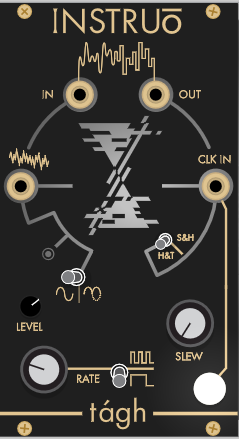
At its core, tágh combines five functions:
Noise generator
Sample & Hold
Hold & Track processor
Slew limiter
- Attenuator
This combination makes the module particularly useful in generative patches, where random voltages and evolving control signals play an important role.
The Internal Noise Source
When nothing is patched into the module, tágh uses its internal noise generator as the source for random voltages.
This means the module can immediately generate useful modulation signals without requiring any external modules.
The internal noise source feeds the Sample & Hold or Hold & Track section, creating continuously changing control voltages.
Internal Clock
Tágh also contains an internal clock.
The clock rate is controlled by the large frequency control and can operate in different timing ranges.
This allows the module to generate slow evolving voltages or rapidly changing modulation patterns.
External clock signals can be used as well whenever synchronization with other parts of a patch is required.
Level and Polarity Controls
The LEVEL control determines the range of voltages generated by the module.
This makes it possible to create:
subtle modulation,
medium-range variation,
- wide random voltage swings.
A polarity switch allows operation with either:
positive and negative voltages,
- or positive voltages only.
This is particularly useful when modulation targets react differently to bipolar and unipolar control voltages.
Multiple Functions in One Patch
One of the strengths of tágh is flexibility.
You can use:
only the noise source,
only the Sample & Hold section,
only the Hold & Track functionality,
- only the slew limiter,
or combine all functions together.
For example, patching the Noise Output back into the module's input creates a self-contained random voltage generator capable of producing a wide range of evolving CV values.
Why tágh Is Useful for Generative Music
Generative patches often require a balance between unpredictability and control.
Tágh provides both.
Its random voltage generation creates variation, while its level controls, polarity settings, clock options and slew processing make those random voltages musically useful.
For this reason, tágh works exceptionally well as a central utility module in generative systems.
Conclusion
Instruō tágh is far more than a simple random voltage source. By combining noise generation, Sample & Hold, Hold & Track processing, slew limiting and attenuation into one module, it becomes a powerful tool for creating evolving control voltages and generative modulation structures.
Whether used as a self-contained source of randomness or integrated into larger modulation networks, tágh offers a remarkable amount of functionality in a compact design.
Just click here to get more details about this topic, including graphs, presets, patches and videos.
Related articles
- Five Faces of Randomness in Generative Music
- The Turing Machine: Freezing Randomness into Repeating Sequences
- Mutable Instruments Stages: Envelope Generator, LFO, Sequencer and Sample & Hold for Generative Music
- Befaco Rampage Explained: One of the Most Powerful Generative Modules in Modular Synthesis
- Sample & Hold vs Track & Hold: Understanding the Difference in Modular Synthesis
- Using Instruō tágh for Random CV Generation and Generative Music