Modulating Reverb Tails in Generative Music
What Happens When Reverb Decay Time Is Modulated?
Modulating Reverb Tails in Generative Music
Reverb is often treated as a static environment surrounding a sound.
Generative music encourages a different perspective.
The acoustic space itself can evolve over time.
Why Modulate Reverb?
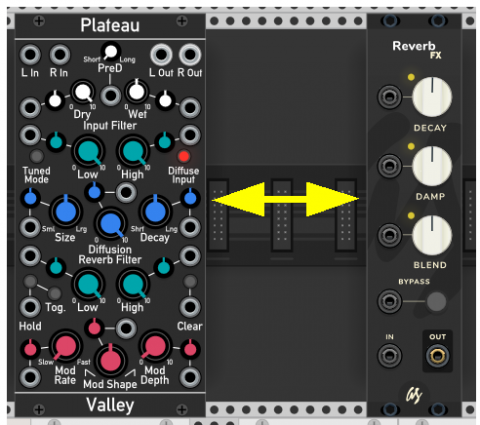
Many reverbs provide numerous parameters:
decay time,
damping,
room size,
diffusion,
- tone controls.
Among these, decay time is one of the most universally available and musically effective modulation targets.
Corrugated Reverb Tails
When decay time changes while sounds are already inside the reverb, unusual effects emerge.
The direct sound remains unchanged.
The reverberation itself changes shape.
The result resembles a reverb tail that develops its own internal echoes and ripples.
Rather than echoing the source sound, the system appears to echo the reverberation process itself.
Applications
This technique can be particularly effective in:
ambient music,
soundscapes,
cinematic textures,
- generative installations.
Subtle modulation often produces the most convincing results.
Reverb as a Living Space
Instead of placing sounds inside a fixed room, modulation turns the room itself into an evolving musical element.
The perceived environment becomes part of the composition.
Conclusion
Modulating reverb decay time introduces movement into the acoustic space itself. The result is often more interesting than adding further modulation to the original sound source.
Just click here to get more details about this topic, including graphs, presets, patches and videos.