
Mutable Instruments Clouds: Granular Synthesis for Generative Modular Music
How Does Mutable Instruments Clouds Work for Granular Synthesis and Generative Music?
Mutable Instruments Clouds: Granular Synthesis for Generative Modular Music
Granular synthesis is one of the most powerful techniques available to modular synthesists. Instead of processing audio as a continuous stream, granular processors divide sound into tiny fragments called grains. These grains can then be rearranged, layered, stretched, repeated, and transformed into entirely new textures.
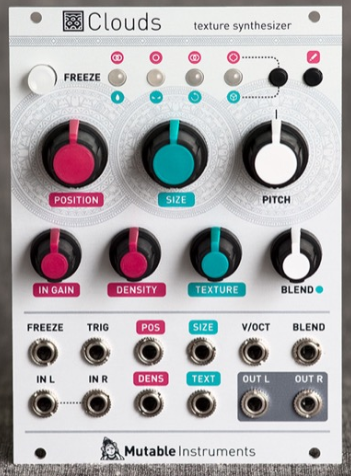
Among modular musicians, Mutable Instruments Clouds became one of the most influential granular processors ever created. It combines granular synthesis, audio buffering, modulation capabilities, and ambient effects in a single module.
Clouds exists in several forms:
Original Mutable Instruments hardware
Softube Modular software version
VCV Rack "Joni"
- VCV Rack "Neil"
The VCV Rack versions are inspired by different firmware versions of the original hardware and provide access to much of the module's functionality inside a software modular environment.
Why Clouds Is Useful in Generative Music
Generative patches often produce evolving melodies, rhythms, drones, and textures. Clouds can capture these sounds and continuously reshape them into new sonic material.
Instead of generating notes directly, Clouds transforms existing sounds into evolving atmospheres, making it ideal for:
Ambient music
Soundscapes
Experimental music
Generative compositions
- Hybrid modular productions
A simple sequence can become a continuously evolving texture that develops independently from the original source.
Audio Buffer and Freeze Function
At the heart of Clouds lies an audio buffer.
Incoming audio is continuously recorded into this buffer. Clouds then creates grains from the stored material.
One of the module's most useful features is the Freeze function.
When Freeze is activated:
New audio stops entering the buffer.
Existing audio remains available.
- Clouds continues generating grains from the captured sound.
This effectively turns a short moment of audio into raw material for extensive exploration.
A frozen buffer can become:
A drone source
A granular texture
A harmonic cloud
- An evolving atmospheric layer
For generative music, Freeze creates moments of stability inside otherwise constantly changing systems.
Just click here to get more details about this topic, including graphs, presets, patches and videos.
Related articles
- Mutable Instruments Clouds Controls Explained: Position, Size, Texture and Density
- Mutable Instruments Clouds Blend Functions, Effects and Audio Quality Settings
- Using Mutable Instruments Clouds in Generative Music and Ambient Sound Design
- Befaco Rampage Explained: One of the Most Powerful Generative Modules in Modular Synthesis
- Mutable Instruments Stages: Envelope Generator, LFO, Sequencer and Sample & Hold for Generative Music
- Mutable Instruments Marbles Time Domain Explained: Random Rhythms, Gates and Probability
- 4ms Spectral Multiband Resonator Morph Function and Envelope Follower Explained