
Mutable Instruments Grids Explained: Algorithmic Rhythm Generation for Generative Music
How Does Mutable Instruments Grids Generate Rhythms in Modular Synthesis?
Mutable Instruments Grids Explained: Algorithmic Rhythm Generation for Generative Music
Rhythm is one of the most important structural elements in generative music. While many modular musicians build rhythms from clock dividers, trigger sequencers, Euclidean generators, or probability modules, Mutable Instruments Grids approaches rhythm generation from a different perspective.
Rather than programming individual beats, Grids creates complete rhythmic structures algorithmically. It acts as an intelligent rhythm generator that continuously produces drum patterns while allowing the user to move through a large space of possible grooves.
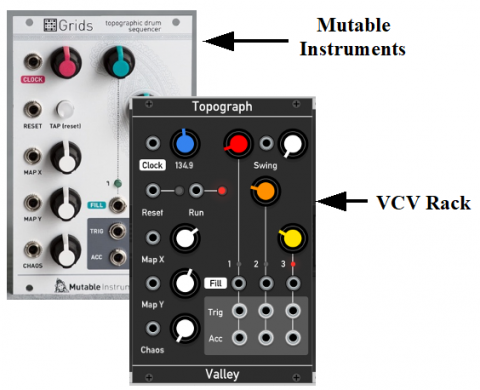
The original hardware module by Mutable Instruments has become a classic of Eurorack systems, and its functionality is also available in VCV Rack through the module called Topograph.
What Is Grids?
The official description calls Grids a:
"3-channel, algorithmic, rhythmic pattern generator."
In practical terms, Grids generates three synchronized rhythm streams that can be used to trigger kick drums, snares, percussion voices, envelopes, samples, or any other event in a modular system.
Instead of entering individual beats step by step, the user explores a large collection of rhythm patterns using two primary controls:
MAP X
- MAP Y
These controls move through a multidimensional space of rhythms. Every position produces a different combination of three related rhythmic patterns.
You can think of it as exploring a landscape of rhythms rather than programming them manually.
Exploring the Rhythm Space
The easiest way to understand Grids is to imagine a large collection of drum grooves hidden inside a box.
The MAP X and MAP Y controls allow you to move through that box and reveal different rhythmic combinations. Small changes can create subtle variations, while larger movements can generate completely different grooves.
This makes Grids particularly useful for generative music because:
rhythms can evolve continuously,
transitions can remain smooth,
pattern exploration becomes intuitive,
- modulation can create endless variation.
Applying CV modulation to MAP X and MAP Y allows the rhythm itself to become part of the generative process.
Three Rhythm Channels
Grids provides three trigger outputs.
These outputs typically control:
kick drum patterns,
snare drum patterns,
- percussion or hi-hat patterns.
However, nothing limits them to drum sounds. Any triggerable event in a modular system can use these outputs.
Examples include:
envelope generators,
sample players,
sequencers,
granular processors,
logic networks,
- switching systems.
The result is a flexible rhythmic control center that can drive entire generative patches.
Adding Complexity with Fill Controls
After finding a rhythm you like, Grids allows additional complexity through three FILL controls.
These controls introduce extra notes into the rhythm patterns.
Rather than replacing the original groove, they enrich it by increasing activity and density.
This makes it possible to move gradually between:
sparse rhythms,
medium-density grooves,
- highly active rhythmic textures.
In generative compositions, slow modulation of the Fill parameters can create long-term development without changing the overall character of the rhythm.
Clocking Options
Grids can operate using either:
its internal clock,
- or an external clock source.
To use external synchronization, the clock control must be turned fully counter-clockwise.
This allows Grids to synchronize with:
master clocks,
DAWs,
clock dividers,
sequencers,
- generative timing networks.
The hardware version additionally includes a TAP button for setting tempo manually.
Advanced Options
Holding the TAP button on the hardware version enters the module's options menu. In VCV Rack these functions are accessed through menus.
Important options include:
Pulses Per Quarter Note
Available resolutions are:
4 PPQN
8 PPQN
- 24 PPQN
Higher resolutions allow more detailed rhythmic structures but require faster incoming clock signals.
A common beginner mistake is using 24 PPQN with a slow external clock, resulting in rhythms that appear extremely slow.
Swing
Swing introduces timing offsets that make rhythms feel more human and less mechanically rigid.
Trigger or Gate Outputs
The three rhythm outputs can generate either:
short trigger pulses,
- or longer gate signals.
Gate mode is especially useful when driving envelope generators instead of percussion modules.
Euclidean Sequencer Mode
Grids can also operate as a Euclidean rhythm generator.
This expands the module far beyond its original drum-pattern concept and provides access to another powerful family of rhythmic structures widely used in generative music.
The Chaos Control
One of the most interesting controls on Grids is CHAOS.
The Chaos parameter introduces controlled irregularity into the generated rhythms.
As the value increases:
additional beats appear,
unexpected accents emerge,
- patterns become less predictable.
Importantly, Chaos does not simply create random rhythms. Instead, it perturbs the existing groove while preserving much of its underlying structure.
This makes Chaos particularly valuable for generative music, where a balance between predictability and surprise is often desirable.
Slow modulation of the Chaos parameter can create evolving rhythmic landscapes that remain coherent while continuously changing.
Accent Outputs
In addition to the three primary rhythm channels, Grids provides ACC outputs.
These outputs generate short pulses at rhythmically important moments within the pattern.
The accents can be used to:
trigger additional percussion,
open VCAs,
influence modulation systems,
switch signal paths,
- emphasize structural points in a composition.
The module determines which beats receive accents internally. The user does not explicitly define these accent positions.
Why Grids Works So Well in Generative Music
Many rhythm sequencers require constant programming and editing.
Grids takes a different approach.
Instead of building rhythms step by step, the user explores a large space of pre-organized rhythmic possibilities and then introduces variation through:
MAP X modulation,
MAP Y modulation,
Fill controls,
Chaos modulation,
clock manipulation,
- external CV sources.
The result is a system that continuously generates fresh rhythmic material while maintaining musical coherence.
For generative composers, this balance between order and variation is exactly what makes Grids such a powerful creative tool.
Conclusion
Mutable Instruments Grids is much more than a drum trigger sequencer. It is an algorithmic rhythm generator designed to explore rhythmic possibilities through navigation, modulation, and controlled unpredictability.
Its combination of pattern mapping, fill controls, chaos processing, accent generation, and Euclidean sequencing makes it an exceptionally useful module for generative music systems.
Whether used for percussion, melodic triggering, modulation events, or complete generative compositions, Grids provides a practical way to create evolving rhythms that remain musical while continuously changing.
Just click here to get more details about this topic, including graphs, presets, patches and videos.
Related articles
- The Turing Machine: Freezing Randomness into Repeating Sequences
- Mutable Instruments Stages: Envelope Generator, LFO, Sequencer and Sample & Hold for Generative Music
- Five Faces of Randomness in Generative Music
- Random Harmonic Progressions in Generative Music Using Sequential Switches
- Using Pitch Dependency in Generative Music
Related books
Tags - Knowledge Base
- Generative Music
- Modular Synthesis
- VCV Rack
- Book Excerpt
- Mutable Instruments Grids
- Grids Tutorial
- Algorithmic Rhythm Generator
- Generative Rhythm
- Modular Drum Sequencer
- VCV Rack Topograph
- Generative Percussion
- Euclidean Sequencer
- Modular Rhythm Patterns
- Chaos Rhythm Modulation
- Accent Outputs
- Drum Pattern Generator