Using Befaco Rampage as an Envelope Generator and Slew Limiter
How Do the Envelope Generator and Slew Limiter Functions of Befaco Rampage Work?
Using Befaco Rampage as an Envelope Generator and Slew Limiter
At the heart of Rampage are two identical attack-decay generators.
Each section provides adjustable rise and fall times and offers three response characteristics:
Exponential
Linear
- Logarithmic
These different response curves significantly influence how a modulation evolves over time.
When triggered, Rampage behaves as an attack-decay envelope generator. The rise control determines how quickly the voltage increases, while the fall control determines how quickly it returns to zero.
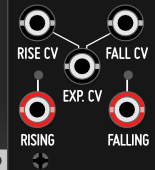
Each section includes individual CV inputs for rise and fall modulation. This makes it possible to create continuously evolving envelope shapes using LFOs, Sample & Hold modules, sequencers or other modulation sources.
A particularly useful input is the EXP CV input. Unlike the dedicated rise and fall CV inputs, EXP CV controls both stages simultaneously.
An important characteristic of this input is that increasing the incoming control voltage shortens both rise and fall times.
When an external signal is patched into the signal input, Rampage changes its role completely and operates as a slew limiter. In this mode, incoming voltages are smoothed according to the selected rise and fall settings.
This makes Rampage useful not only for generating modulation but also for reshaping existing modulation signals.
The combination of envelope generation and slew processing allows a single Rampage section to act as a powerful tool for creating complex and evolving control voltages.
Just click here to get more details about this topic, including graphs, presets, patches and videos.